
A priest who is notorious for his promotion of rapprochement between Freemasonry and Catholicism has renewed calls for ‘dialogue’ to end the Church’s long-standing condemnation of the secret sect.
by Kathy Clubb
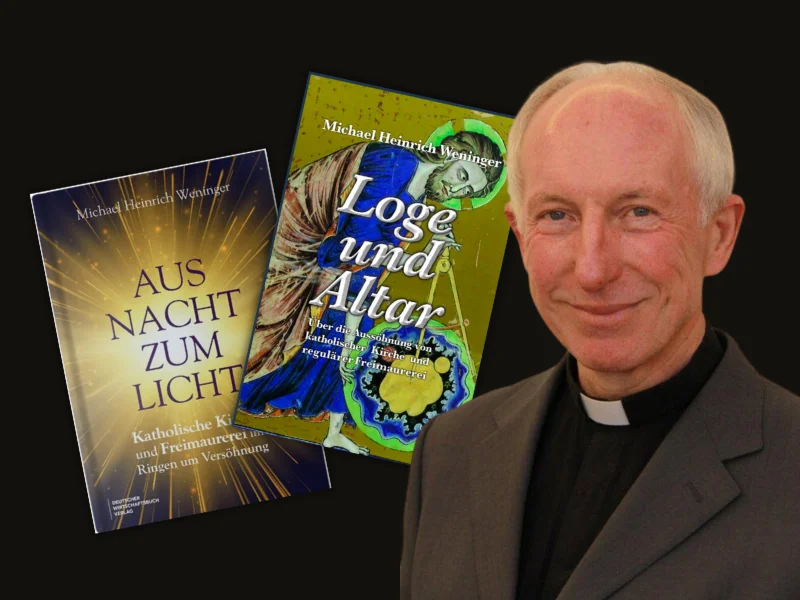
The former diplomat and now Catholic priest, Fr. Michael Weninger has been touring through Germany promoting his cause, creating grave scandal through his ‘Synodal’ approach.
Lecture tour on “Catholics and Freemasons”
The German Catholic media outlet, Aus.sicht (Outlook) reported on Fr. Weninger’s recent lecture evening at the St. John’s Lodge “Zum Füllhorn” in the city of Lübeck, Germany. Founded in 1772, the lodge operates under the Grand Landlodge of the Freemasons of Germany and practices the Swedish Rite, which is specifically for ‘Christian’ Masons. The name, “St. John’s Lodge”, is the standard German term for a “Blue Lodge”,1 and is named after John the Baptist and John the Evangelist.
The lecture was entitled, “Catholics and Freemasons – opponents or brothers?“ and sought to debunk the Cuurch’s prohibition on Freemasonry from historical, cultural, and intellectual perspectives.
Fr. Weninger stated,
“A Freemason is basically a good person who works on himself to become an even better one. As a Catholic priest, I can’t find anything wrong with that for now“.
He is also quoted as saying that “A genuine Freemason must be religious, otherwise he cannot be a Freemason” and that the “great architect”, whom we know to refer to satan, is the “creator God.”
“Millions” of Catholic Freemasons?
According to Fr. Weninger, there are 1.4 million Catholics who also claim allegiance to Freemasonry. He justifies the dual allegiance by specifying that it is not excommunicable if the lodge is ‘regular’, (i.e., not politically subversive) with a ‘belief in God’ as part of its constitution and no politically active members. In fact, Weninger refers to Masons who attempted to subvert governments as “pseudo-Freemasons.”
Weninger pointed to “thousands of clerics” being Freemasons at its origins in the late eighteenth century: “Thousands, I beg you, one has to let that sink in, thousands of clerics were Freemasons.“
It would be of great interest to know if this claim is true; the number could be this vast, with ignorance of the Church’s teaching being so widespread, even within the hierarchy.
Indeed, since ‘dialogue’ was first proposed over a century ago, Freemasonic forces have barely taken their foot off the accelerator, to the point where funerals for Catholic Masons are becoming a common occurrence in Europe.
The 1983 Code of Canon law misrepresented
As could be expected, Fr. Weninger referenced the 1983 Code of Canon Law in his talk. However, he claimed that the Code had nothing to say about Masonry:
“In the new canon law that is valid today, Freemasonry and Freemasons no longer appear at all. And certainly not in the criminal law part of canon law.”
It is almost impossible to attribute his comment to either ignorance or to genuine misinterpretation. For while the claim is accurate in the literal sense2 – the Code does not mention the words, “Freemasonry” or “Freemasons” – it is clear that these groups fall under the category of ‘associations which plot against the Church’.
Further, the clarification which was famously released the day before the new Code came into force by then-Cardinal Ratzinger leaves no room for doubt. In his capacity os head of the Congregation for the Doctrine of the Faith, Ratzinger wrote:
Therefore the Church’s negative judgment in regard to Masonic association remains unchanged since their principles have always been considered irreconcilable with the doctrine of the Church and therefore membership in them remains forbidden. The faithful who enrol in Masonic associations are in a state of grave sin and may not receive Holy Communion.
From this we can see why it is imperative for Masons and their sympathisers to show that ‘modern’ Freemasonry is concerned with ‘making good men better’ rather than subverting the Church.
Only those who are extremely naive or wilfully ignorant could believe that the centuries-long plot by Freemasonry to destroy its sworn enemy, the Catholic Church, has been forgotten in favour of nice feelings and getting along.
In the audience at Fr. Weninger’s talk was Dr. Klaus Kottmann, head of the canon law department of the Archdiocese of Hamburg. Like Fr. Weninger, Kottmann has produced scholarly articles which attempt to present Masonry in a good light.
He endorsed the priest’s commentary adding that he personally knows “many Catholic Freemasons who say that Freemasonry does not contradict the Catholic faith but can complement it.”
Is he a Freemason?
In 2014, Fr. Weninger violated the Church’s teaching to became chaplain for three Masonic lodges. The role was conferred in an official ritual which was held alongside Masonic ‘consecration ceremonies’ for the same lodges, with Weninger celebrating a Catholic Mass in honour of the ‘consecrations.’
A report from that occasion refers to Fr. Weninger as ‘Brother’; this title is only given to men after they have completed the ritual making them an ‘Entered Apprentice’, which is the First Degree of Freemasonry:
Bro. Rev. Michael Weninger officiated at the Mass which was attended by most masons present of all faiths as well as local villagers, this being their local church. Bro Rev Michael was installed and Invested as Chaplin in each of the three lodges Installation ceremonies during the day being well qualified since he lives in the Vatican as a member of the Pontifical Council for Inter-religious Dialogue but works in Rome. [Source – Provincial Grand Lodge of Mark Master Masons]
While there is no solid proof of Fr. Weninger’s Masonic allegiance, one can be forgiven for concluding that he is, in fact, a member, given this reference to him as “Brother”, as well as his obvious sympathy in general to Freemasonry.
Insiders have revealed a well-established sequence for seducing a priest into Freemasonry: once he has been targeted as someone who is both talented and ambitious, he is then lured by flattery or extortion into taking part in the rituals.
As a prominent member of the Curia, Fr. Weninger would have made a perfect candidate for this kind of machination. Ordained by the outrageously-heterodox Cardinal Christoph Schönborn of Vienna, it was the latter who encouraged Weninger to complete his dissertation on the compatibility of Freemasonry with Catholicism. That paper later became Fr. Weninger’s first book, Lodge and Altar.

Weninger’s later book, From Night to Light, is even more troubling. The blurb accompanying the book states that,
Today, a Catholic Freemason is treated under canon law in the same way as any other Catholic. There is no longer a distinction between Masonic and non-Masonic Catholics. It can be stated with certainty that no Catholic is prevented from joining a Masonic association, no Catholic Freemason is excommunicated because of his membership in Freemasonry, is therefore in a state of grave sin and is therefore excluded from participation in the sacraments, unless he himself is guilty of machinations against the Church.
This statement is manifestly erroneous, yet Fr. Weninger has never been publicly chastised for his claims but has rather been praised and elevated by the hierarchy.

Freemasonic infiltration
In a recent interview, Bishop Athanasius Schneider pointed to the influence of Freemasonry as one of two serious infiltrations which have attacked the Church, the other being “ecclesiastical modernism.”
In misrepresenting the Church’s relationship with Masonry while giving the Brotherhood the appearance of respectability, Fr. Weninger gives force to both of those evil currents.
“O Mary, conceived without sin, pray for us who have recourse to Thee, as well as for those who do not have recourse to Thee, especially the Freemasons.”
Kathy Clubb is an Australian writer who has written on Catholic and pro-life issues at The Remnant Newspaper, Family Life International, LifeSiteNews, Fidelity magazine, Endeavour Forum and more.
Kathy is the founder and editor of Pax Orbis.
- The first three degrees of Freemasonry ↩︎
- The relevant reference from the Code of Canon Law: Can. 1374— A person who joins an association which plots against the Church is to be punished with a just penalty; one who promotes or takes office in such an association is to be punished with an interdict. ↩︎

Leave a Reply