
Peter Kwasniewski wants to guide traditional Catholics. But he has done a gross disservice to his Catholic readers by recommending the works of John Wu without reservation as a guide to Catholic mysticism.
by Vinicius
This follows shortly upon his unqualified support for William Wallace’s From Evangelical to Catholic by Way of the East, which asserted Hindu Yogis have the means of salvation and Nirvana is “heaven”.
Kwasniewski declares,
“One of the most wonderful authors I’ve gotten to know is… John C.H. Wu…He fully recognizes the infinite distinction between the orders of nature and of grace” in his “fascinating fusion of Chinese Wisdom and Carmelite Spirituality”.
Among Wu’s works “highly recommended” by Kwasniewski is Chinese humanism and Christian spirituality: essays of John C.H. Wu. 1

John Ching Hsiung Wu standing in ambassadorial attire next to a statue of the Virgin Mary. The photograph was likely taken in the late 1940s (circa 1947) when he served as the Minister Plenipotentiary of the Republic of China to the Holy See. SOURCE
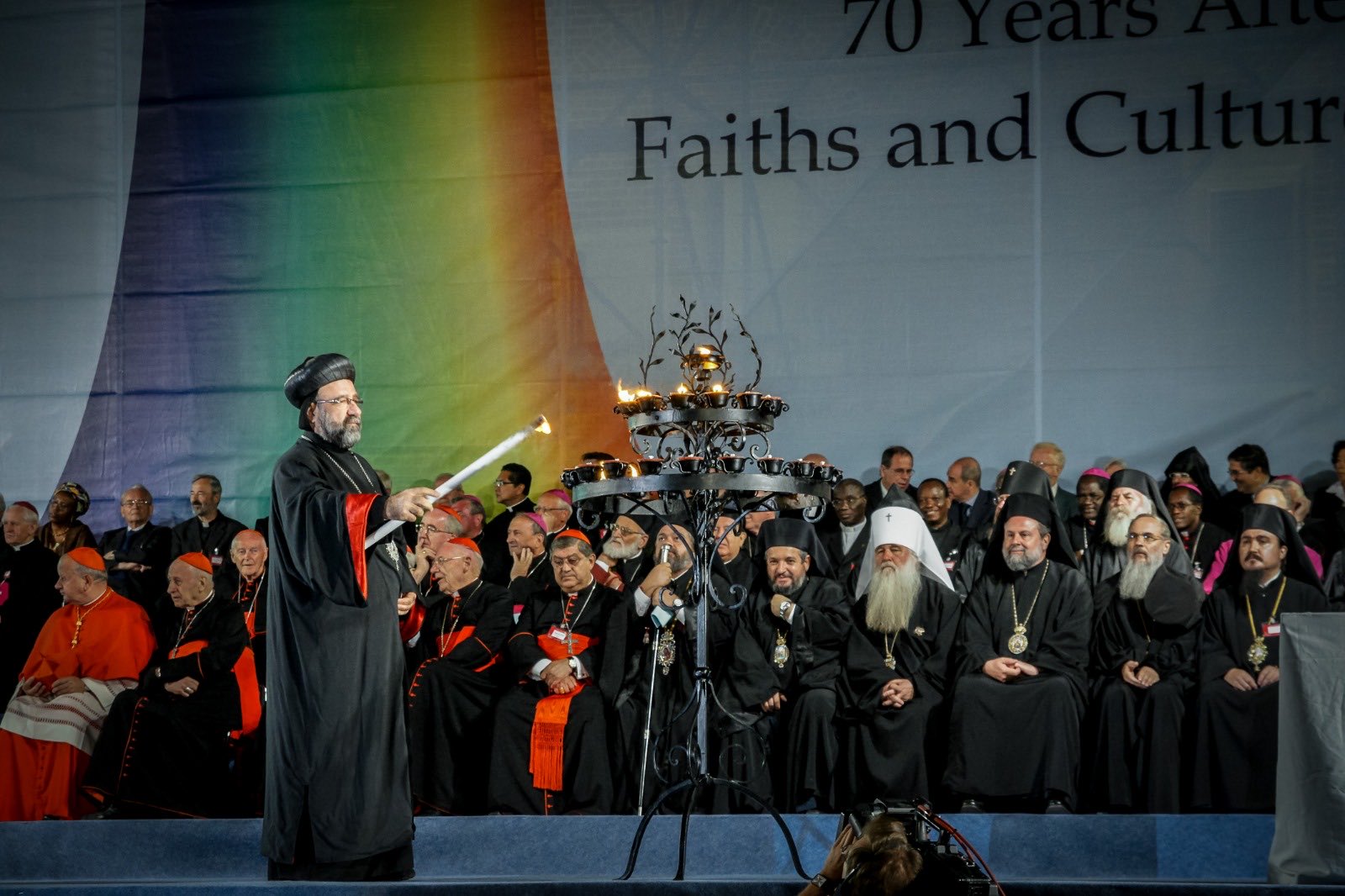
Wu’s conversion from paganism to Catholicism is admirable. But his works teach a religious syncretism that is on a par with the worst excesses of the 1986 Assisi meetings and is incompatible with the faith. While it may be understandable that some converts from paganism hang onto mistaken views, this syncretism cannot be dumped on defenceless Catholics as a guide to mysticism or the faith, as Peter Kwasniewski does.
Moreover, Wu’s works make it clear that his religious syncretism is by no means his own invention; he was heavily influenced by false mysticism from the West, as his reliance on the modernist/occultist Anglican author, Evelyn Underhill shows. John Wu could have been remembered as well-intentioned but misguided due to the intellectual fashions of the time. Kwasniewski’s misrepresentation of him as a Chinese Chesterton makes it necessary to subject Wu’s ideas to criticism.
Wu’s core error is that oriental pagan religions are a “natural” approach to God and religion, like that of Aristotle. This is false; Taoism, Hinduism and Buddhism deny God and do not engage in any reasoning to prove His existence. Instead, they are based on falsehood and often invoke plainly diabolical entities. To make matters worse for Wu’s religious vision, he also declares that pagan “natural theology” is based on “mystical” connections with God – yet without “grace”. This is a contradiction in terms. Nor is there any mysticism in the superstitious beliefs and gods referred to by Wu.

John C. H. Wu (1899-1986) was brought up in a non-Christian environment. A prominent jurist, he converted to Methodism in 1918, and to Catholicism in 1937. He had thirteen children and from 1946 to 1949 was ambassador of the Republic of China to the Holy See, where he formed a close association with Archbishop Montini (the future Pope Paul VI) based on shared ideas.
Wu quotes Paul VI when he was Archbishop of Milan asserting that technology would one day take the place of nature as the “intermediary” between God and man. Wu concludes: “The good Archbishop predicted that “the dawn of this new spirituality is not far off”. With hindsight we can see how Wu’s hopes were misplaced. Let’s examine his views.
John Wu’s Chinese Humanism and Christian Spirituality is intended to justify the “mystical” credentials of several pagan religions of the East: “It seems that all mystics, Christian or pagan… talk the same language”; “To my mind, the Tao itself is but a pointer to the divine Logos”. “[Taoist] Chuang Tzu is a mystic through and through”. 2 But Chuang Tzu was a sceptic and his Tao was merely a natural cosmic force, not God. Scepticism and atheism are not the fruits of true mysticism.
Next, Wu associates Taoist paganism with Carmelite spirituality because [Taoist founder] Lao Tzu’s idea of the “Tao” as feminine is “like” St Therese of Lisieux, who Wu asserts saw God as a mother. But Wu immediately ruins his defence of paganism as “mystical” by declaring, “Taoism is natural wisdom, while Christianity is supernatural wisdom”. 3
This is the constant contradiction in all Wu’s works that exemplifies the complete lack of judgement in Kwasniewski’s assertion, “[Wu] fully recognizes the infinite distinction between the orders of nature and of grace”. Just five pages prior to this, Wu asserts that “the Divine Logos” “taught” Lao Tzu through mysticism.
Indeed, throughout Wu’s writings Buddhism and Taoism are held up as the product of true mysticism, while in the same texts he declares that they are just natural, rational human wisdom. The truth is that, as “natural theology”, Taoism, Buddhism and Hinduism cannot be taken seriously because there is almost no rational validation of their mutually contradictory beliefs. Wu seems to argue that Catholics
should take them seriously by presenting them as the fruit of “mysticism”. However, the Church has always judged “mysticism” by its conformity with the faith.
Wu foreshadows Assisi’s vision of the incomplete, “Travelling Church”.
Wu declares, “We Christians should take care not to think that we alone possess God while the pagans have no knowledge of God at all. The truth is that we are fellow seekers after God”. 4 This confuses “possession” of God in the sense of sanctity, with the true faith. This fallacy might have seemed original before Vatican II, but it has been shamelessly repeated by modernists ever since: “nobody is holy
enough to claim to know the truth or say that another belief is false”.
But Catholics very gratefully do possess the truth while pagans do not. The Apostles didn’t go the ends of the Earth to give an update on what people already believed and practiced, but to bring light where there was darkness.
One of Wu’s main messages is that of the incomplete Church, which needs fusion with pagan traditions of the East in a new “spiritual age” to finally become whole. This aligns with the view of paganism as the “gentile Old Testament” (Sebastian Morello’s thesis in his book published by Kwasniewski), so beloved of Scottish rite Freemasonry whose strategy is to operate within Churches.
However, the Old Testament, and the New, teach that all paganism was evil. Wu is oblivious, asserting that Buddha, Lao Tzu, Confucius and Mencius were “heralds of Christ”. In the same vein as Pope Francis’ unfortunate speech asserting religious pluralism as willed by God, he writes,
“Whatever differences there may be between East and West, can
only be in the accidentals, not in the essentials; and we may be sure that such differences… are permitted to exist that they may express the infinite glory of God”. 5
It is absolutely false to say that these differences are not essential.
Christianity itself is in error if it fails to synthesise with paganism?
For Wu,
“If we want to convert the East, we must find the real East within ourselves”, “If… we should go to a pagan country… with the wrong-handed idea that its culture belongs to the devil… [converts] would not be converts to Catholicism but rather to provincialism”. 6
His assumption is that the Church is lacking; it needs “Eastern” mysticism, femininity etc. In this discussion Wu muddies the waters by referring to the “West” describing the effects of secularism, the industrial revolution and liberalism, when he mainly includes the Church under the same label. Obviously the defective West is not the Church and never has been. The Church, on the other hand, has been complete and lacking in nothing since its foundation.
By discussing the West/Church as one thing, Wu is able to view the Church as an evolving body needing synthesis with the “East” (in whose definition he also confuses natural traits like national character or language, along with evil religions, as one whole): “[Because] Christianity is the only possible synthesis between East and West”… the starting point must be the person of Christ”, “Certain qualities and modes of thinking” of peoples of East and West “must” be assimilated. Wu states this in a book validating the false beliefs, not the natural qualities, of pagans. In the confusion, he skirts the fact that pagan falsehood cannot be “natural” to any people.
Wu neglects to warn against meditation techniques of the religions he discusses that empty the mind and the will, doing this as they deny the beliefs of true religion and replace them with superstitions and invoke sinister personages. These practices are attacked by every genuine Catholic authority on spirituality as opening a door to demonic activity in a person. Does Peter Kwasniewski know this? Does he warn the readers he dispatches to Wu’s syncretism of what Wu does not warn of?
The work continues to confuse religious syncretism and the traditional Church: “Just as St Augustine and St Thomas and others ‘baptised’ Plato, Aristotle and the Stoics, so we must know how to “baptise” the pagan philosophers of the ancient East and the modern West”. Here Wu misrepresents Pius XII’s encyclical, Evangelii praecones as a justification for his religious syncretism. Pius XII employed the analogy of the Church using the pagan philosophers of antiquity with conserving what is good in non-Christian cultures today, in their language, art, music etc. Nowhere does he use Wu’s phrase “baptising paganism”, because nothing could be further from Pius XII’s intentions.
Instead, Pius XII says
“Whatever there is in the native customs that is not inseparably bound up with superstition and error will always receive kindly consideration and, when possible, will be preserved intact”.
Indeed, in the Americas, where most Catholics live today, Amerindians were converted without syncretism, but retained their language and culture. Instrumental in this, Our Lady of Guadalupe
appears as half-Amerindian-half Spanish and surrounded by symbolism that in no way affirms or syncretises with the previous religions.

The millions who converted embraced something new and unheralded by their former religions. Now, nobody even remembers those beliefs, just as modern Germans have to read Tacitus to know a little of what their ancestors believed. However, Wu concludes declaring that the union of pagan East and the West will give birth to “the new man”.
Wu’s autobiography, Beyond East and West (1951), expresses his religious syncretism more fully. Again, he confuses the natural order with grace and mysticism:
“Humanly”, “nothing is greater” than the three pagan eastern religions; but then, the “indigenous religion of the Chinese people, the religion of heaven and good conscience… that all the minor deities are His (God’s) emissaries, that all religions have but one purpose – to make men good… Such is the natural religion”. 7
Wu’s confusion of “natural” and supernatural is everywhere. There is nothing natural about “minor deities” as “divine emissaries”, and to refer to such ravings or evil spirits as such is appalling.
John Wu confuses the orders of nature and grace. On one hand, Wu “thinks of himself” as a mage offering the pagan religions of China to the infant Jesus; on the other hand, having been brought up a pagan, he feels like “a contemporary of the first disciples of Christ, who… lived their lives under the domination of the law and were suddenly introduced into the reign of grace”. 8 Wu admits that paganism was not quite “on a par” with the Old Testament, but his analogy infers only a difference of degree not essence between paganism and the true religion of the Old Testament.
What is more, the OT was not merely a natural religion of “law”; it was revealed by God and blessed with grace by anticipation of Christ. Beyond East and West ignores this essential character of the true religion separating it essentially from all other religions. This is the ideology of the Assisi meetings.
Wu’s autobiography also misinterprets Chinese religions, claiming that Confucianism’s term Heaven/Tian affirms belief in God, whereas Confucianism’s “Heaven” is only a kind of natural cosmic life-force, even in the writings of Confucius (Chinese Catholics are banned by the Church from using the Confucian term “heaven” to refer to God). Wu affirms “Tao” as God, and that Taoism’s founder discovered this through “true mysticism”. 9
He extolls Taoist meditation as a true mystical path directed towards God (comparing it enthusiastically with the Hindu Bhagavad Gita), whereas it is a false method with no belief in God; it is a “religion” of the cosmos, of which Tao’s “heaven” is a part. Taoism focuses on the secular world, not the afterlife, which is viewed as the return to the cosmos through reincarnation.
Avoiding discussion of the rank delirium of Buddhist belief, Wu wrongly claims that Buddha was really more a moral teacher than a religious teacher”. Buddhism, however, denies the most essential beliefs of the true religion. He admits that Buddhism is mistaken in denying God (yet “I often think of [Buddha] as a foreshadowing of Christ”) but declares that the Hinduism of the Bhagavad Gita is the contemplation of “God”.10
Buddhism is dangerous as well as false. The Buddhism officially espoused by Manchu China in which John Wu grew up in involved “deity yoga” where the practitioner had to lose his self and become the embodiment of a particular “god”. He could also attempt “transfer of consciousness”. Suffice to say, this is not mere moralising, but extremely dangerous superstitions that open the door to diabolical
influence. He considers Zen Buddhists true mystics:
“I have inherited from Buddhism an intense longing for “the other shore [Nirvana], which is but another name and a faint foreshadowing for the Kingdom of God”. 11
But “Nirvana” is anything but heaven. This is pagan superstition, not “natural wisdom”.
Not so exotic after all: Wu’s Western occultist influencers
Wu quotes a long passage with which he is “in full accord”: “In [Catholic saints] ‘natural mysticism’… came to itself… and attributing for the first time true and distinct personality to its Object… Christian philosophy… finds truth in a hundred different systems, accepts and elucidates Greek, Jewish and Indian thought, fuses them in a coherent theology, and says to speculative thinkers of every time and place, ‘Whom therefore ye ignorantly worship, Him declare I unto you’”. 12
This defines Christian philosophy as a fusion of Kabbalistic, classical pagan and Hindu ideas. It describes the saints as practitioners of “natural mysticism”, whereas they were privileged by true mysticism, which is supernatural. The passage also implies that the Old Testament saints did not have a spiritual life of intimacy with the true God. This passage is lifted from a work by the Anglican occultist, Evelyn Underhill (1875-1941), Mysticism.

Underhill’s ideas were based on occultism and liberal ideologues like Henri Bergson. She was attracted by Catholicism, but decided to become an Anglican instead because of Pope St. Pius X’s anti-modernism. Her “spiritual director” was the Catholic modernist Friedrich von Hügel, who very narrowly escaped being excommunicated by Pius X.
Underhill is on the liturgical calendar of the Anglican Church but obviously cannot be on the Catholic calendar. This did not prevent Ordinariate priest, Fr K. Hagan, from writing an enthusiastic article on Underhill and her work, Mysticism. 13 This is an indictment on the state of the Ordinariate (Peter Kwasniwski is not known to have ever publicly criticised the Ordinariate).
Sinister influence of Evelyn Underhill
Since the Ordinariate appears as another of those “cracks” Paul VI referred to but this time emitting high church modernist fumes, it is worth looking at Underhill’s views because Catholics will be confronted with them sooner or later.
Underhill’s idea of Christian mystic champions was a very bad example for Wu:
“An impassioned Christian of a deeply mystical type, Blake, like Eckartshausen and Saint-Martin, was at the same time a determined and outspoken foe of conventional Christianity”. 14
She calls William Blake a “mystical genius”, but his views were very close to overt satanism. Underhill is agnostic religiously:
“I understand [mysticism] to be the expression of the innate tendency of the human spirit towards complete harmony with the transcendental order; whatever be the theological formula under which that order is understood… Whether that end be called the God of Christianity, the World-soul of Pantheism, the Absolute of Philosophy… is the proper subject of mysticism”.
Throughout her work Underhill cites Louis Claude de Saint-Martin, the founder of Martinism, the ideology of Scottish rite Freemasonry.
Like Tomberg and Kwasniewski, Underhill argues for practitioners of the “mystical path” to find some kind of organised religious tradition in which to practise:
“[mysticism is] most usually founded upon the formal creed which the individual mystic accepts… he is generally an acceptor and not a rejector of such creeds… the great mystics [are] faithful sons of the great religions… Thus the Sufis were good Mohammedans, Philo and the Kabalists were orthodox Jews.”
But “attempts… to limit mystical truth… to the formulae of any one religion, are futile”. 15 Despite being on the Anglican liturgical calendar, Underhill was agnostic, “the true mystic – the person with a genius for God – hardly needs a map himself” but “he is always willing to use the map of the community [i.e. religion]in which he finds himself”. 16
Underhill advocated Scottish rite Freemasonry’s strategy of using Church institutions:
“Further, the Christian atmosphere is the one in which the individual mystic has most often been able to develop his genius in a sane and fruitful way… This alone would justify us in regarding it as representing, at any rate in the West, the formal side of the true tradition: the ” path of least resistance ” through which that tradition flows.” 17
Wu experienced a falling away faith before a long process of accepting Catholicism. It is hard to know how seriously influences like Underhill’s stunted his understanding of the faith and conditioned his ideas of what he was doing in embracing the Catholic Church.
Wu’s confusion
It is astonishing that Wu could affirm that “The East has gone further in its natural contemplation [of God] than the West has in its supernatural contemplation”, 18 when none of these religions have even a minimal concept of God through natural reasoning. Wu’s confusion of the spiritual with the supernatural was deeply flawed, “The rhythms of [of pagan Chinese] life are in perfect accord with the cosmic rhythms”, “It is because the typical Chinese regards himself as a microcosm that he feels at home in the bosom of the Macrocosm”. 19
Wu compares the many-armed Hindu goddess of death and destruction to Our Lady as the expression of the feminine, recounting what he believed to be a consoling death: “The great Hindu, Sri Ramakrishna, drew his inspiration from devotion to Kali ‘the Divine Mother’. It is most touching to read that on his last day… he cried in
ringing tones three times the name of Kali, his Divine Mother, before he entered into his final ecstasy”. 20
Kali, by definition and depiction, is a diabolical figure, and looks about as feminine as Terminator. Unlike innumerable compatriots of Wu who have converted, and turn away in disgust from the false deities of paganism, Wu’s ideological imports from Western occultism and false mysticism seem to have prevented the acquisition of healthy Catholic reflexes to such abominations.
This is not the only instance of Wu’s alarming syncretism. While discussing his pagan father’s exemplary life (he was sure he had gone to heaven), Wu says he died in a kind of ecstasy:
“Seven days after his death, it was reported to us one evening, a pedlar possessed by a spirit had seen a vision of my father sitting in the city temple”. 21
An ordinary Catholic reflex would be to regard such “news”, as alarming but Wu recounts it matter-of-factly as one more indication of his father’s happy afterlife. It insinuates that pagan temples and the “possessed” are conduits for the “divine”.
This article does not judge Wu’s heart. He and his wife were very devoted Catholics and raised a large exemplary family, including one priest. There is a charming photo of his family with Pius XII (the unprecedented group setting was arranged by Archbishop Montini). We all know exemplary Catholics who have bizarre views even on religious topics.
When dangerous views are publicised, however, especially to vulnerable people like many in Kwasniewski’s target audience, it becomes everyone’s business to refute them. We live in times of confusion, and Kwasniewski’s high church modernism is a threat in English-speaking circles where clarity is needed. Wu’s syncretism might have been a step forward from paganism; for Catholics, it is a step into darkness.
By Vinicius. Vinicius is a Melbourne-based historian-researcher focussing on early modernity as the Christian Western alternative to ideological, Enlightenment modernity.
- Peter Kwasniewski, Tradition and Sanity, 29/8/26 ↩︎
- Chinese humanism and Christian spirituality: essays of John C.H. Wu, Saint John University Press, New York 1965, pp. 107, 91, 89. ↩︎
- ibid, pp. 99, 120. ↩︎
- ibid, p. 153. ↩︎
- ibid, p. 158. ↩︎
- ibid, p. 163. ↩︎
- John Wu, Beyond East and West, Sheed and Ward. New York 1951, pp. 12, 60-61. ↩︎
- Wu, Beyond East and West, pp. 149-150. ↩︎
- ibid, pp. 161-162. ↩︎
- ibid, p. 198. ↩︎
- ibid, p. 185. ↩︎
- ibid. ↩︎
- Mysticism in the Anglican Tradition, Ordinariate Observer, Vol 1, n. 3, 2024. ↩︎
- Evelyn Underhill, Mysticism, Dutton, New York 1912, p. 562. ↩︎
- ibid, p. 115. ↩︎
- ibid. ↩︎
- ibid, p. 126. ↩︎
- Wu, Beyond East and West, p. 350. ↩︎
- ibid., pp. 355-356. ↩︎
- ibid, p. 359. ↩︎
- ibid, p. 24. ↩︎

Leave a Reply