
During the month of November, it is especially appropriate to begin or renew our devotion to the Holy Souls in Purgatory. This article contains several resources to make your November contemplations more fruitful.
You may also appreciate this meditation on the Holy Souls.
- Purgatory in the Divine Plan
- Purgatory as dogma by Archbishop Lefebvre
- The Holy Souls and St. Peter Damian
- Holy Souls book

Purgatory in the Divine Plan
Purgatory occupies an important place in our holy religion: it forms one of the principal parts of the work of Jesus Christ, and plays an essential role in the economy of the salvation of man.
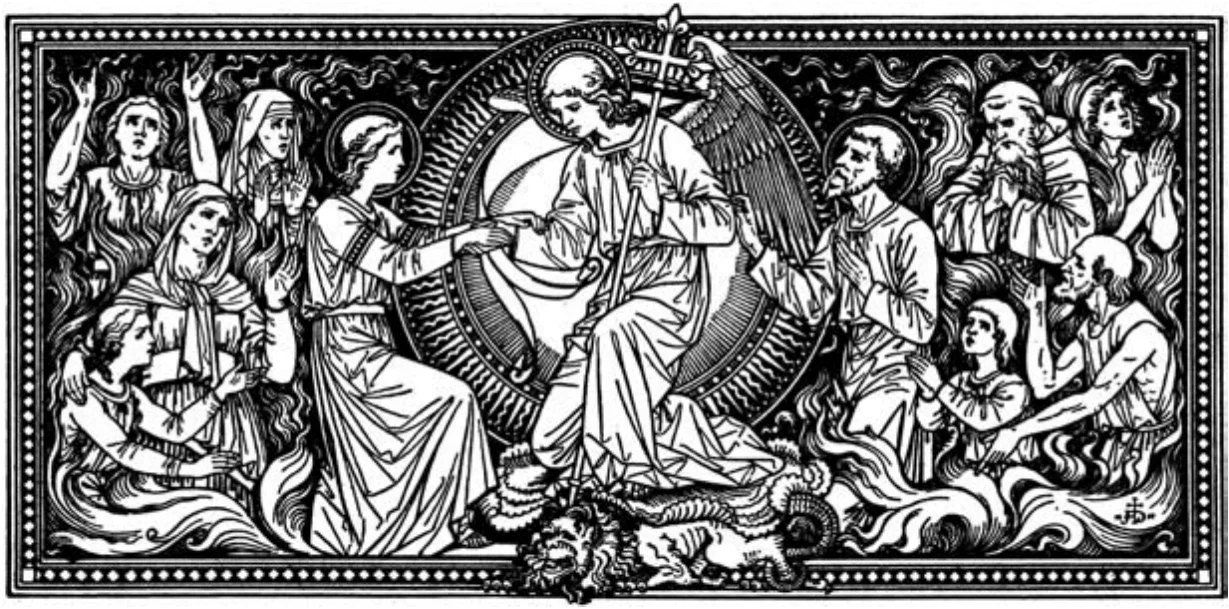
Let us call to mind that the Holy Church of God, considered as a whole, is composed of three parts: The Church Militant, the Church Triumphant, and the Church Suffering, or Purgatory. This triple Church constitutes the mystical body of Jesus Christ, and the souls in Purgatory are no less His members than are the faithful upon earth and the elect in heaven. In the Gospel, the Church is ordinarily called the Kingdom of Heaven; now Purgatory, just as the heavenly and terrestrial Church, is a province of this vast kingdom.
The three sister Churches have incessant relations with one another, a continual communication which we call the Communion of Saints. These relations have no other object than to conduct souls to eternal glory, the final term to which all the elect tend. The three Churches mutually assist in peopling heaven, which is the permanent city, the glorious Jerusalem.
What then is the work which we, members of the Church Militant, have to do for the souls in Purgatory? We have to alleviate their sufferings. God has placed in our hands the key of this mysterious prison: it is prayer for the dead, devotion to the souls in Purgatory….
Prayer for the departed, sacrifices, and suffrages for the dead form a part of Christian worship, and devotion toward the souls in Purgatory is a devotion which the Holy Ghost infuses with charity into the hearts of the faithful. It is a holy and wholesome thought, says Holy Scripture, to pray for the dead, that they may be loosed from sins. (II Machab. xii, 46.)
In order to be perfect, devotion to the souls in Purgatory must be animated both by a spirit of fear and a spirit of confidence. On the one hand, the sanctity of God and His justice inspires us with a salutary fear; on the other, His infinite mercy gives us boundless confidence.
This fear of Purgatory is a salutary fear; its effect is, not only to animate us with a charitable compassion toward the poor Suffering Souls, but also with a vigilant zeal for our own spiritual welfare. Think of the fire of Purgatory, and you will endeavour to avoid the least faults; think of the fire of Purgatory, and you will practise penance, that you may satisfy Divine Justice in this world rather than in the next.
Let us, however, guard against excessive fear, and not lose confidence. Let us not forget the mercy of God, which is not less infinite than His justice. Thy mercy is great above the heavens, says the Prophet;1 and elsewhere, The Lord is gracious and merciful: patient, and plenteous in mercy.2 This ineffable mercy should calm the most lively apprehensions, and fill us with a holy confidence, according to the words, In te, Domine, speravi, non confundar in æternum -“In Thee, O Lord, I have hoped; let me never be put to confusion.”3
If we are animated with this double sentiment, if our confidence in God’s mercy is equal to the fear with which His justice inspires us, we shall have the true spirit or devotion to the souls in Purgatory.
Purgatory as Dogma
The following is an excerpt from a sermon by Archbishop Lefebvre on the Holy Souls. This section deals with proofs that Purgatory is a dogma to which all Catholics must adhere.
Purgatory is a dogma – a dogma of our Faith. Whoever refuses to believe in Purgatory is a heretic. In fact, already in the thirteenth century, the Second Council of Lyons solemnly affirmed the existence of Purgatory. Then, in the sixteenth century, the Council of Trent in particular, solemnly affirmed against the negations of the Protestants, the necessity in preserving the Faith, of believing in the existence of Purgatory. It is therefore certain that this is a dogma of our Faith, which is especially affirmed and supported by Tradition – more than by Sacred Scripture.
Sacred Scripture does, however, offer passages, which make allusion, as clearly as possible, to the existence of Purgatory. We have, moreover, in an epistle which is used by the Church in Masses offered for the intention of the souls in Purgatory, the account of the “Machabees” where Judas Machabee sent a sum of twelve thousand talents to Jerusalem asking the priests of offer a sacrifice for the intention of the soldiers who had died in combat in order that they might be delivered from their afflictions and enter heaven.
Sacred Scripture adds: “It is a salutary thought to pray for our dead.” Saint Paul also makes allusion to the souls in Purgatory when he says that certain souls enter heaven immediately and others quasi per ignem; that is, who enter heaven as well but by fire, making allusion certainly to the purification necessary for these souls who would not be perfectly prepared to enter heaven.
It is by these allusions and particularly by Tradition, which is transmitted to us by the Apostles and by the Fathers of the Church, that the Church has founded her Faith in the existence and in the reality of Purgatory.
St. Peter Damian and the Holy Souls
Peter Damian lost both Father and Mother shortly after his birth. One of his brothers adopted him but treated him with unnatural harshness, forcing him to work hard and giving him poor food and scanty clothing. One day Peter found a silver piece which represented to him a small fortune. A friend told him that he could conscientiously use it for himself as the owner could not be found. The only difficulty Peter had was to choose what it was he most needed, for he was in sore need of many things. While turning the matter over in his young mind it struck him that he could do a still better thing, viz, have a Mass said for the Holy Souls in Purgatory, especially for the souls of his dear parents. At the cost of a great sacrifice he put this thought into effect and had the Mass offered.
The Holy Souls repaid his sacrifice most generously. From that day forward a complete change became noticeable in his fortunes. His eldest brother called at the house where he lived and, horrified at the brutal hardships the little fellow was subjected to, arranged that he be handed over to his own care. He clad him and fed him as his own child, educated and cared for him most affectionately.
Blessing followed on blessing. Peter’s wonderful talents became known and he was rapidly promoted to the priesthood, sometime after he was raised to the episcopacy and finally created Cardinal. Miracles attested his great sanctity so that after death he was canonized and made Doctor of the Church.
These wonderful graces came to him after that one Mass said for the Holy Souls. – SOURCE
Holy Souls Book
The reflection on Purgatory in the Divine Plan comes from the Holy Souls Book, Meditations on Purgatory by Father F. X. Lasance. The book may be downloaded below, or to purchase, please go here.



Leave a Reply