
Jewish Messianism as the undercurrent of the errors of Russia — this was the light I hoped to shed with my Pax Orbis article of March 23, 2026 and which I now continue to explore.
by Jakob Soefting
It took its starting point in Dr. Douglas Haugen’s recent book Saints of the Apocalypse (2026) and then developed into a sort of wildly annotated, selective bibliography of various works which have approached this subject.
If we were to expand on the topic of Jewish Messianism in general, i.e., to leave the specifics of Fatima temporarily aside, I would suggest an even more recent book, one published after my article: True Israel and False Judaism (DeReggio1, 2026, 216 pp). This important and interesting study is by the prominent French SSPX theologian, Fr. Jean-Michel Gleize, who was for many years professor of ecclesiology and dogma at Écône.

It is new only to the English-reading world. The original French edition was published in 2018 by a small publishing house, Éditions Iris. In 2022, it appeared in a Polish edition, from another small publishing house, the same which has now also dressed the work for the first time in English clothes.
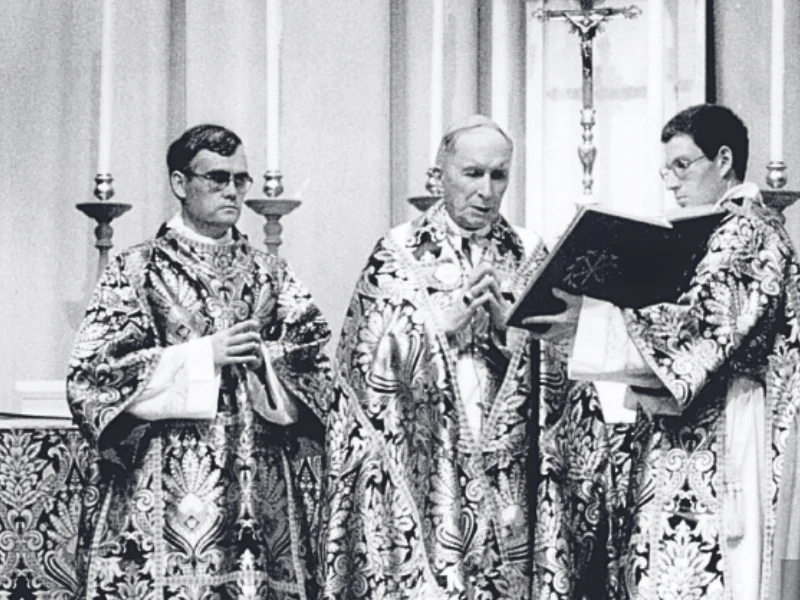
This short article can obviously not show what Fr. Gleize shows – even in great summary. It can only offer a few glimpses of a few basic points. Simultaneously, I mean to amuse myself by inferring some parallels to words of Abp. Marcel Lefebvre.
But first a note on the layout of the book. After a somewhat lengthy but very interesting preface it follows a clear Thomistic structure: three questions and fifteen articles.
The first Q is prolegomena and the second is a pre-study of the old and temporary state of the Covenant. The third Q, the “main part,” adheres closely to the well-known method of St. Thomas Aquinas’ Summa, with its for-and-against arguments, essential principles of the answer, and responses to the arguments.
The six articles in this section are: Are they Jews Unfaithful? Are the Jews Guilty of Deicide? Are the Jews Unfaithful and Guilty of Deicide as a People? Is the Jewish People Subject to Divine Reprobation? Will Judaism be a Mystery of Conversion? Do the Conciliar and Post-Conciliar Teachings Express Catholic Doctrine on Judaism? The book is closed by a conclusion.
Already in his preface Fr. Gleize summarises the program of Jewish messianism; the utopia which is becoming the concrete realization of the Jewish people’s reprobation:
“The globalist idea of the unity of the race is therefore, according to Judaism, a religious idea, and it is necessarily connected to the priestly role assigned to the Jewish people. It is the idea of the universal monarchy of the Messiah of Israel, reigning over the whole earth from the Temple rebuilt at long last.
The people of Israel will be the priests of humanity. But the realization of this universal monarchy requires the destruction of Christianity, the destruction of the religious power of Catholic Rome and the political power of Christian societies, and the destruction of the social reign of Christ the King.
The reconstruction of the Temple of Jerusalem thus goes hand in hand with this expectation of the destruction of Christianity and of the political and spiritual power of the Rome of the Popes.” (p. 15f)
As we saw in my previous article, Abp. Marcel Lefebvre expressed it in like manner, as quoted in Bp. Bernhard Tissier de Mallerais’ Marcel Lefebvre: The Biography (2004):
“Since Israel refused the true Messiah, it would give itself another messianism that is temporal and earthbound, dominating the world by money, Freemasonry, Revolution, and social democracy. [—] The worldwide designs of the Jews are being brought about in our time, but they started with the foundation of Masonry and the Revolution which has decapitated the Church” (p. 603).
In my previous article, after discussing Zionism as an error of Russia, we easily connected it to Jewish messianism. Fr. Gleize concurs through Youssef Hindi, in Occident et Islam (2015): the “key to understanding Zionism” is “Jewish messianism.” He adds that Zionism is the vector and precursor of the Clash of Civilizations strategy, the matrix of current and future civil and international wars. Fr. Gleize makes an interesting point when he says that the tension between the State of Israel and the Diaspora forms the two branches of the dialectic of Jewish messianism.
The idea and outline of Gleize’s book is not, as we have seen, to discuss Jewish messianism as such. It is a theological study of the conciliar church’s novel and revolutionary ideas of Judaism and the Church, contrasted to the perennial teaching of Holy Mother Church. The former, in other words, swept in through a hijacked Council, and found its first expressions in Trojan horse-documents like Nostra Aetate (1965). Personally, I would add that there certainly is ground for discussing if the Council’s very root cause isn’t also to be found in this context.
“There is […] a considerable difference […] in the new ‘magisterium’ that emerged from Vatican II, which attests to a profound change in doctrine. [—] This change in doctrine is unacceptable […] because it goes against the teachings of Divine Revelation and contradicts the very words of God as expressed in Scripture and in the Tradition of the Church, as the Magisterium always faithfully transmitted it for twenty centuries, until the Second Vatican Council. This is what the following pages intend to show” (p. 26ff).
The first thing to realise, is what Judaism is:
“a reality that is theologically (and therefore essentially and fundamentally) distinct from the Old Covenant. Although chronologically it comes after Abraham and Moses […], it does not proceed from them” (p. 56).
It is a new movement, risen out of apostasy. A reality which the Council turned on its head, and with that the understanding of the fundamental Ecclesia-Synagoga enmity: “The Church was fully aware of this antagonism from the beginning and all throughout history.”

This awareness of course survived in Churchmen like Abp. Lefebvre, who for instance stressed in The Spotlight (July 18, 1988):
“Judaism […] is far more distant from us [than Islam] [—]. Judaism […] is the heir to the system which crucified our Lord. And the members of this religion, who have not converted to Christ, are those who are radically opposed to our Lord Jesus Christ. [—] They are in opposition to the very foundation and existence of the Catholic faith on this subject. [—] This is one case where there cannot be the slightest compromise without destroying the very foundation of Catholic faith.” (p. 6)
Similarly, the Archbishop, in his posthumous book Against the Heresies (1997), said:
“Being the inheritors of those who crucified Our Lord, they are essentially against the Church. [—] They have always worked against the Church. [—] It is fantastic.” (p. 291)
With that, let’s go back to Fr. Gleize:
“The Jewish religion is by definition an essential rejection of Jesus Christ. In other religions, therefore, even if the founder explicitly wanted to reject Christianity, this rejection is merely the rejection of one competitor among others, and not a refusal to fulfill his own vocation as a religious leader; whereas the Jewish authorities, by rejecting Christianity, refuse to fulfill their mission as religious leaders.
Lastly, even more concretely, in other religions, this rejection in no way implies the murder of the person of Jesus Christ: Muhammad, for example, did not commit deicide; Judaism murdered the one it rejects. Judaism exists precisely because it rejects Christ, whom it should, by definition, that is, by divine vocation, officially recognise as the Messiah. [—]
Judaism is by definition the antithesis of Christianity, in what must be considered an opposition of deprivation.” (p. 175f) 2
“[T]hroughout all of history, Judaism can only oppose Christianity. This fact is not only historical; it is formally revealed and derives as a theological necessity” (p. 180f).
Fr. Gleize leans here, as in several other places in this book, on the interesting Argentine, Fr. Julio Meinvielle (1905–73) 3 and not the least his book El judío en el misterio de la historia (1936) — a work which Fr. Gleize nominates as the most formal theological recapitulation of this perennial awareness of enmity (but which, however incredibly enough, still does not exist in English, but only in French and German):
“Christianity and Judaism must run into each other everywhere without ever reconciling or merging. They represent in history the eternal struggle of Lucifer against God, of darkness against Light, and flesh against the spirit. A terrible enmity because it is theological.” (p. 181)
As Fr. Gleize puts it, Judaism is an essential component of sacred history, a part of the theology of history. He speaks to the reality of the Deicide (a truth that is proxima fidei and certain in theology), its ratification by the Jewish people as such, describing it, with French theologian Jean Cardinal Daniélou, S.J. (1905-74), as “a mysterious collective economy.”
Fr. Meinvielle highlights the magnitude of what we are dealing with here when he talks of the eschatological conversion of the Jews, saying that it is a meta-historical fact that is truly eschatological because “it will put an end to a factor that drives history: the tension between Jews and Gentiles.”
“Thus is fulfilled the prophecy […]: Israel according to the flesh […] continues to persecute the true Israel […]. As has been rightly observed, this enmity is ‘terrible because it is theological.’ It is a necessary enmity, because it is based on the very person of Jesus Christ, and its necessity has been revealed to us by God.
The conciliar declaration Nostra Aetate fails to address the profound reasons for this antagonism. That is why, with this declaration, and even more so with the subsequent developments drawn from it by John Paul II and Benedict XVI, the Second Vatican Council failed to profess an important part of Revelation for the Catholic faithful to believe.
The so-called ‘magisterium’ that has followed the Council has done even worse, since not content with sinning by this omission, it has introduced into its teaching a radically false idea, contrary to Revelation, according to which the Old Covenant, far from being abrogated, still deserves the respect and consideration of believers.” (p. 203f)

Also Father’s point on persecution is paralleled by Abp. Lefebvre in Against the Heresies (1997):
“[I]t is the Jews, after all, who persecuted the Christians. The Christians did not persecute the Jews. Just the contrary is true.” (p. 291)
On his last page, Fr. Gleize stresses what Catholics really do owe Jews: Charity. We have a mission. Because, and this is his ending words, “The true Israel is the Church.” The Jews must find their way home.
Fr. Gleize points out that everything the conciliar church so far has done is not even close to winning “the goodwill of the Jews,” as has been clearly pointed out by Jewish voices themselves, saying that Nostra Aetate was “a far cry from the solemn act of reparation” needed, and that “unless she renounces Christ, the Catholic Church can never hope to be reconciled with Judaism.” This renouncing reconciliation process could be suitably described as a part of the historical realisation of what the prominent 19th century Rabbi, Elie Benamozegh 4, termed La Catholicité d’Israël” the progression of Catholicism into Kosher “Catholicism.” 5 It works patiently in steps under the name of Modernism.
Lastly, I would like to draw one more Fr. Gleize–Abp. Lefebvre parallel, but from an different area which is presently on our minds. Abp. Lefebvre said in a press conference on June 15, 1988, i.e., two weeks prior to the consecrations, in response to the Vatican’s threat of canonical sanctions:
“Excommunication by whom? By a modernist Rome. [—] One cannot say that when there is a gathering such as Assisi, one is still Catholic. It is not possible.
One cannot say that, when there is Kyoto, and the declarations which were made to the Jews at the Synagogue, and the ceremony which took place at Santa Maria in Trastevere last year, no? In the heart of Rome! C’est scandaleux, absolumment scandaleux. It is not Catholic any more.
So we are excommunicated, by the modernists: by the people who have been condemned by the previous popes. Alors, what could that really do to us? We are condemned by people who are themselves condemned, because they are people who should be condemned publicly.”
Fr. Gleize expressed himself more briefly, in an article in La Porte Latine (May 13, 2026) 6, several weeks prior to the latest round of consecrations:
“Excommunicated? But by whom? By those who receive the blessing of a schismatic woman, the Archbishop of Canterbury, Sarah Mullaly? By those who authorize the blessing of Fiducia Supplicans? And who kneels before Pachamama?”
The day after, Fr. Davide Pagliarani’s “Declaration of Catholic Faith Addressed to Pope Leo XIV” (of May 14, 2026), stated in its the very opening sentence that Our Lord “rendered the Old Covenant definitively null and void.”
That right there is one of the central points of Fr. Gleize’s book. Out of what is contained in that one sentence grew an undercurrent powerful enough to deeply impact the current state of the Church and the world.
by Jakob Soefting
ENDNOTES
- https://dereggio.org/ ↩︎
- Cf. the words of Fr. Gabriel Billecocq, SSPX, in “Vatican II and the Jewish Question,” The Angelus, Jan.-Feb., 2016: “Judaism (under the New Covenant) is necessarily defined as the antithesis of Catholicism. It only exists in opposition to and negation of Catholicism […]. Judaism is the rejection of the Messias, of Jesus Christ whom the Jews put to death, and therefore of the Church [—]. It is inherent contradiction, perhaps the worst blindness possible. [—] [M]odern Judaism is death-dealing in every sense [—]. It is a lamentable fraud.” (p. 80) ↩︎
- Cf. Frs. Michael Crowdy & Kenneth Novak, SSPX, “The Mystery of the Jewish People in History,” The Angelus, Apr., 1997. ↩︎
- In this context I would recommend as further reading, professor of history Joël Morin’s (1965-2022) excellent article “The Law of Noah: One World Religion?” in The Angelus, Feb.-Mar., 2004. ↩︎
- In this context one could, for instance, recommend the book by Fr. Daniel Le Roux, SSPX, which comments on this process – the ‘Judaisation of the Catholic Church’ – during the time of John Paul II, i.e., Peter, Lovest thou Me?: John Paul II: Pope of Tradition or of Revolution?” (1989, orig. French ed., 1988), which also contains a short but interesting postface by Abp. Marcel Lefebvre. Worth mentioning here is also a book published by Éditions Fideliter, in other words by the SSPX. Hubert Le Caron de Chocqueuse’s (1920-88) Dieu est-il antisémite?: l’infiltration judaïque dans l’Eglise conciliaire (1987), which argues for how modern accusations of antisemitism reinterpret traditional teachings as hatred rather than theology. They are used to silence theological realities, so that the relationship between Christianity and Judaism can be continuously redefined. See also John Sharpe’s “Judaism and the Vatican”, and Fr. Michael Beaumont’s, SSPX, “Jewish-Catholic Dialogue against the Catholic Faith”/”Syllabus of Errors Taken From the Jewish-Catholic Dialogue,” both in The Angelus, no. 6., 2003. ↩︎
- https://laportelatine.org/actualite/a-propos-de-la-declaration-recente-du-cardinal-fernandez-13-mai-2026?hl=en-AU ↩︎



Leave a Reply