
This article describes the early history of the Latin Mass revival during the 1970’s around Melbourne, Victoria including the genesis of two SSPX parishes.
By Marc J de Castella
In my recent article, “A Life Changing Blessing,” I recounted some details concerning the Catholic settlement at “St Benedict’s” in the Upper Yarra Valley, Victoria, Australia. I described the polemics arising from the post-conciliar “reforms,” most notably, the polarising impact of the radical liturgical changes imposed upon the Melbourne Archdiocese in the early to mid 1970’s.
Eager to avoid the unpleasant atmosphere at Rev. Heffey’s community chapel, which was fraught with tension, some families, (including mine), began attending the Novus Ordo at St Joseph’s Catholic Parish in the nearby town of Yarra Junction.
Although it was 1974, Communion in the hand had not yet been introduced. We were blissfully unaware of that impending debacle, with its attendant outrage of “Eucharistic Ministers.” Hence, at that time, Communion was still reverently received, both kneeling and on the tongue.
One Sunday in the latter part of 1977, (unfortunately, the precise date eludes me), we were confronted with a stark reality. The parish priest, Rev. Grabbo, announced the introduction of Communion in the hand, commencing the following Sunday. All parishioners were now required to receive the consecrated Eucharist directly into their cupped hands, dispensing the Real Presence directly into one’s mouth himself/herself. Furthermore, and without exception, Communion would now be received standing.
In a bizarre attempt to justify this sacrilegious imposition, we were then shown several risque, extremely inappropriate photo slides of semi-naked statues of women. The ancient Greek statue of Aphrodite (the goddess of love and beauty), was presented in a lame and overtly ludicrous attempt to demonstrate “there was nothing wrong with the human body…!”
After mass, several parishioners expressed intense dismay, vowing never to return. But where could we attend mass, now that Communion in the hand was to be mandatory throughout the Melbourne Archdiocese?
As a young child, below the age of ten, I acutely remember the fear and confusion which gripped my inexperienced mind. What would become of us? Could we no longer practice our faith? My family and a neighbouring family were truly in a state of Limbo. Of course, the internet, let alone computers, were not available then. We were profoundly worried the Latin mass was no longer celebrated anywhere within the Archdiocese…
The following Saturday, a Catholic neighbour, Michael visited us with his friend, Claude, who lived somewhere in the eastern suburbs of Melbourne.
Claude, a structural engineer, was keen to see the three storey A-Frame house my parents had recently built on our seven acre property. After escorting Claude and Michael throughout the house, we chatted in the kitchen over coffee. My father recounted the dis-edifying experience at mass the previous Sunday. Aware Claude was a practising Catholic, he then asked him whether he knew of the availability of any Latin mass in Melbourne. To our utter amazement and delight, Claude told us both he and his fiance, Paula, regularly attended the Roman Rite (1962 Latin mass). This was celebrated at 5 pm every Sunday afternoon at St Peter’s Parish in Clayton, (a south eastern Melbourne suburb).
Two of the neighbours, (Michael’s brother-in-law, Michael, and Don McLean), soon learnt of this providential discovery. The next day, they both attended the 5 pm mass at the Clayton parish, in order to ascertain, for all of us, whether this was a viable solution.
On Monday evening the next day, they visited. Both men enthusiastically expressed admiration for the liturgy, citing the exceptional solemnity and reverence in which the mass was celebrated by the retired Redemptorist, Rev. Cummins. They described the large attendance, with a distribution of all ages, particularly, young families. The 5 pm mass was celebrated each Sunday alternatively, by Rev. Cummins or the considerably younger parish Dean, Mons. Hodgeson.
The next Sunday, my family attended this 5 pm Latin mass at St Peter’s in Clayton. As a ten year old, I was slightly apprehensive as Sunday approached. One of my older sisters, Nathalie, told me with relish this Tridentine mass would “go on for hours and hours…!” To a young boy, this was hardly a ringing endorsement! I was therefore considerably relieved upon discovering she had greatly exaggerated the anticipated duration of the low mass.
Unlike the usual masterclass in performative piety and the banal and inappropriate attempts to entertain the small congregation at St Joseph’s in Yarra Junction, this liturgy was radically and fundamentally superior.
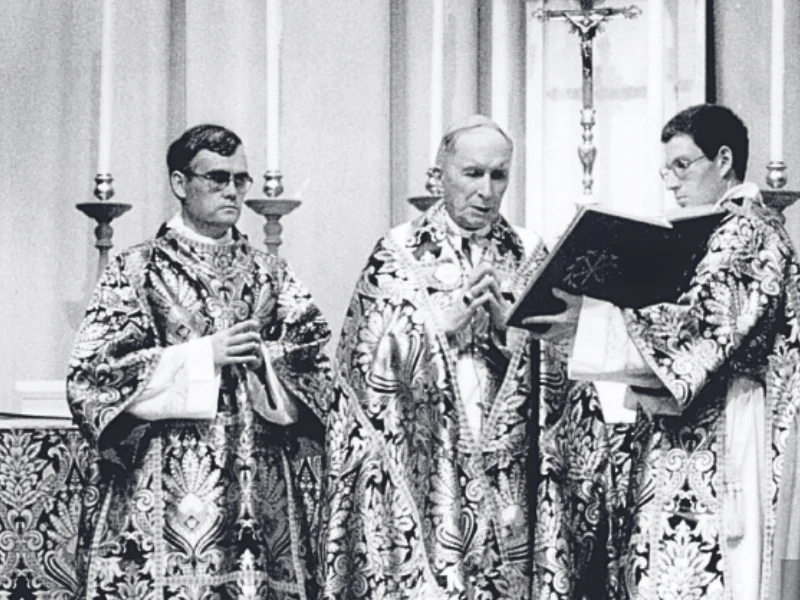
I was immediately struck by the High altar, the dignified vestments in which the priest was attired and above all, the fact he was facing ad orientem (facing the tabernacle, with his back turned to the congregation). Being a low mass, I was both surprised and impressed by the solemnity and reverence in which the altar server and the priest conducted themselves before the High altar.
Having never previously experienced a Latin mass, I was immediately aware this liturgy was God centred, rather than man centred. There was nothing of the inane, psychological numbing and spiritual vacuousness, so distastefully confronting in the typical Novus Ordo mass. Instead, this Latin liturgy possessed a transcendent, Christocentric orientation (telos). This stood in marked contrast to the dis-edifying, uninspiring, anthropocentric (man-centred or humanistic) orientation, so acutely apparent in the Novus Ordo liturgy. The overt inauthenticity and the ontologically 1 deficient theology of the new, vernacular liturgy were remarkably absent here. In the perception of my juvenile mind, it was, essentially, a different faith that was being sublimely manifested upon the impressive High altar…
St Peter’s Church was considerably larger than St Joseph’s at Yarra Junction. Again, I was amazed by the enormous congregation. I was intrigued that most adults diligently followed the liturgy with prayer books (which I later learnt were called “missals”). Whereas parishioners at St Joseph’s generally did not bother to dress respectfully for Sunday mass, everyone here was attired very modestly. Women and girls wore veils and tasteful, feminine clothing. None wore the astoundingly inappropriate, provocative “figure hugging” tight pants or short skirts so utterly ubiquitous in the 1970’s and beyond. Unlike St Joseph’s, crying or restless babies were quickly carried outside, in marked contrast to the rude indifference and appalling negligence of parents at St Joseph’s.
For the next four years, my family attended this Sunday mass. Mons. Hodgeson was then invited by Archbishop Lefebvre to assist Rev. Williamson (later to be consecrated to the episcopate at Econe in 1988), in establishing an SSPX Seminary at Ridgefield in Connecticut, USA. When mass was no longer available after Mons. Hodgeson departed for this august assignment, Rev, Cummins assumed the heavy responsibility of offering Sunday mass at a number of successive rented locations. Eventually, other retired priests offered additional Sunday mass’ in various locations across Melbourne.
Over the following years, Rev. Cummins and his slowly expanding congregation rented a number of halls (and for a short time, a large house), for the celebration of mass. Unfortunately, the rent was often excessively high and the leases were seldom available for renewal. Perhaps, anti-Catholic prejudice accounted for this. In late 1980, the situation became so unstable and tenuous, that Rev. Cummins asked my father and two other men to find a disused church which offered an affordable lease.

After a week of thorough searching, they found a former Presbyterian church, St Andrew’s on Ludstone St, Hampton. The three men generously offered themselves as guarantors for the lease agreement. We were able to successfully lease St Andrew’s from October 1980 until October, 1985, at which time, the SSPX purchased the premises and assumed full ownership. Shortly thereafter, the SSPX established Our Lady of Perpetual Succour and St Andrew Church, as a large and vibrant mass centre.

We finally had a stable, enduring mass centre. Quite elderly and frail at that time, Rev. Cummins continued to assist the SSPX as an auxiliary priest.

Eventually, Our Lady’s Church became so crowded on Sunday mass’ that the need for an additional mass centre became imperative. There was also an acute need for the establishment of an SSPX school, catering for all year levels from Prep. to Year 12.
This led to the purchase of two properties in Tynong, in East Gippsland, Victoria, approximately one hour’s drive from Hampton.

The SSPX parish renovated and extended an enormous shed which, originally, had served as an agricultural trading depot for livestock. Set on nine acres, this building became a truly impressive mass centre for the SSPX faithful, many of whom live in the surrounding towns and open farmland areas, generally within convenient driving distance.
With many trials, tribulations and a plethora of astoundingly timely, providential miracles, the much needed school, St Thomas Aquinas College was eventually established on the second, large, nearby property. This would ultimately cater for all year levels of schooling (both Primary and Secondary).
One particular Providential occurrence bears mentioning here. Several parishioners, directly involved in establishing the school, together with several SSPX priests, were understandably overwhelmed by the excessive costs of the project. They wisely decided to offered a novena to St Thomas Aquinas for the provision of affordable, secondhand classrooms. On this Saint’s anniversary (according to the traditional liturgical calendar), an individual, with a connection to a wrecking company, donated several (otherwise, prohibitively expensive) classrooms. To everyone’s delight, these could be feasibly renovated! Likewise, when other saints were invoked, the assistance sought came to fruition on that particular saint’s anniversary…
The invaluable provision of authentic, wholesome Catholic education, together with the vibrant Traditional Catholic parish community, continues to attract an ever growing arrival of young families. Indeed, an increasing number of Catholics, both young and elderly, are now leaving mainstream Novus Ordo parishes, eager to embrace the uncompromised breadth of Catholic Tradition provided by the SSPX.
The remarkable success of SSPX priests and laity in establishing the Hampton and Tynong mass centres is a testament to prayerful vision and diligent, unwavering perseverance. Undoubtedly, God employed the patient, humble faith of this ridiculed, persecuted remnant to participate in His marvellous work of Catholic restoration. Like the starving Israelites who received manna from Heaven during their sojourn to the Promised Land, or the multitude fed by Jesus in the wilderness through the miraculous multiplication of loaves and fish, God continues to nourish His faithful souls with the uncorrupted, authentic Catholic Faith.
What a great privilege, indeed, to perform even a small role in this great, Divine work…
By Marc J de Castella
Marc de Castella holds an Honours Degree in academic Philosophy from Monash University, Melbourne, Australia. A former Secondary teacher, he lives on almost twenty-one acres near Yarra Junction, in the Upper Yarra Valley, Victoria, Australia. He is currently improving his property, establishing rental accommodation and a small-scale free range egg business. In his spare time, he writes creative fiction and occasional articles on contemporary Catholic issues.
ENDNOTES
- “Ontological” or “Ontology” is a philosophical term referring to the fundamental being or essence of something, that is, its true nature. In asserting the Novus Ordo liturgy is ontologically deficient, I mean that this liturgy is inherently flawed in relation to prior, infallible Dogmatic Church Decrees. The infallible Dogmatic Decrees of the Council of Trent and St Pius V’s Papal Bull, Quo Primum of 1570, provide irrefutable reference points in establishing such liturgical deficiencies in the NOM liturgy. As a Papal Bull, Quo Primum represents the most stringently binding and forceful ruling which a Pope can enact. Quo Primum stipulates its dogmatic decrees have perpetual force, strictly forbidding any future alteration or penalisation of the Latin Roman Rite. On this basis, many contemporary liturgical scholars assert the illegitimacy of the new, vernacular liturgy. ↩︎


Leave a Reply