
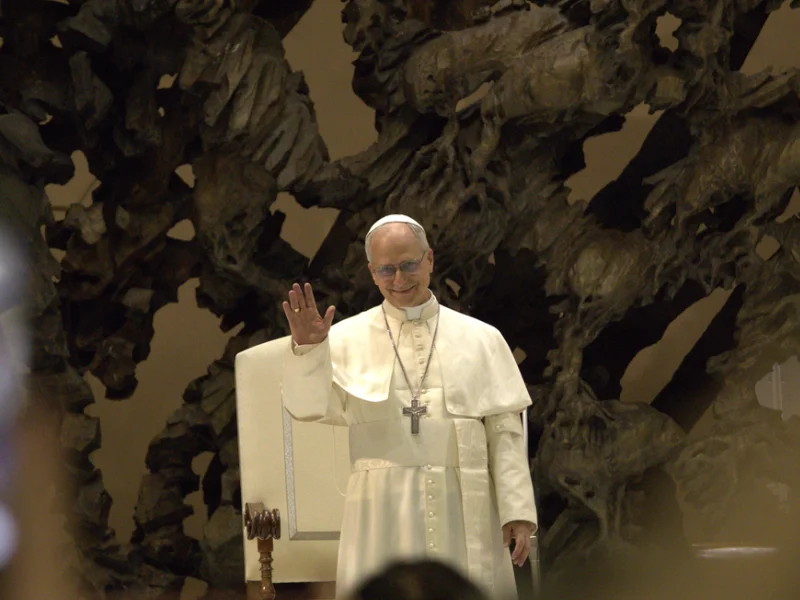
While Pope Leo’s trip to France has been lauded by many for its unparalleled popularity and for his categorical defence of life, the Pontiff’s praise for the principles of the French Revolution reveals the flawed foundation underpinning his apparent success.
The French Revolution’s reality
The Masonic-inspired Revolution of the late 18th century was disastrous for the country of France on both the spiritual and temporal levels. It effectively de-Christianised the once-fervent nation, destroying the Catholic monarchy and introducing secular authority through the principle of laïcité 1 – the humanist doctrine to which the Pope made reference in his address.
Revolutionaries murdered, raped and tortured tens of thousands of French Catholics, including priests, nuns and laity during some of the most blood-thirsty episodes of modern times. Church property was seized and religious orders were dissolved, while on the temporal level, political chaos led to famine which saw the most desperate turn to cannibalism.
France never recovered from the Revolution, instead becoming the world’s ultimate model of a post-Christian society. Its government became infested with Freemasons, with the accompanying collapse of morals; divorce and abortion were legalised and, only weeks ago, euthanasia. This last move was openly hailed as a victory by the Grand Orient Lodge of France.
Over time, France’s Catholic identity has been reduced to a mere cultural note which today is in tension with her enormous Islamic population – a fruit of the unregulated immigration which has led to no-go zones in some parts of Paris. This Moslem influence is so strong that there was even talk of adding minarets to Notre Dame Cathedral during its restoration.
Vive la révolution
Mere hours after his arrival, Pope Leo addressed the Freemason President of the French Republic, Emmanuel Macron, along with the Diplomatic Corps. From his speech:
France is a land with deep Christian roots. From the time of Saint Irenaeus and the baptism of Clovis, the soul of the nation has drawn from Christianity a rich spiritual, cultural, intellectual, artistic and missionary élan that continues to be felt in our world today. So it was that humanism flourished in sixteenth century France, as a means of uniting the heritage of classical Greece and Rome with the Christian faith.
With the great thinkers of the Renaissance, and later of the Grand Siècle, succeeded by those of the Enlightenment, France was responsible for significant advances in our world, including the recognition of human rights grounded in the nature of the human person, particularly religious freedom.
This constant focus on the dignity inherent in every person is echoed in your national motto. Liberty, equality and fraternity are not simply words emblazoned on the front of your public buildings; they refer to universal ethical imperatives that also find in the Gospel message an inexhaustible source of inspiration and fulfilment.
The Pope errs greatly here by admiring the principles of the French Revolution, comparing them to the Gospel message. Pope Pius X, in his 1910 letter to the French Bishops, Notre Charge Apostolique, referred to such a comparison as “blasphemous” when it was drawn by the heretical Sillon movement. Pius accused Sillon members of “Illuminism” and of following “another Gospel.”
Pope Leo went on to praise the Universal Declaration of Human Rights, the humanist document produced by the United Nations in 1948 in Paris, whose ambiguous language and fluid concepts have led to a raft of “rights” being claimed by every progressive force for decades.
Fruits of the Revolution
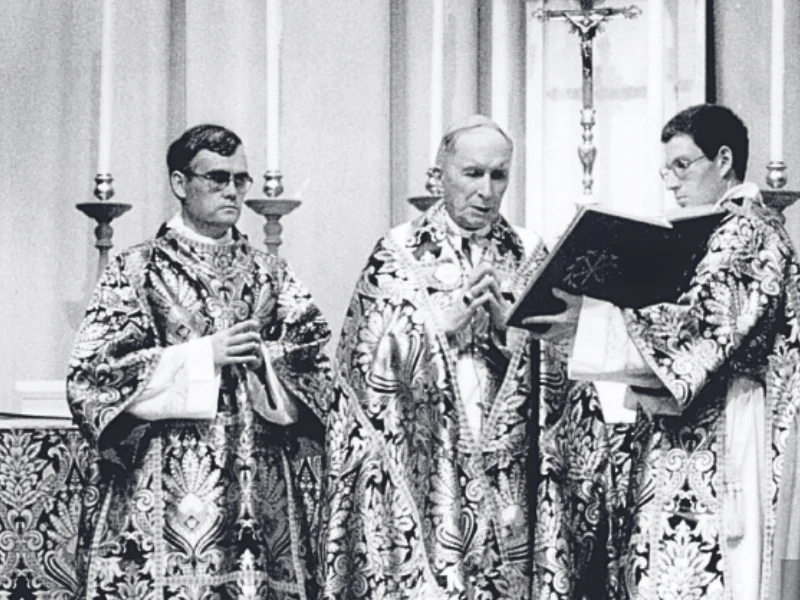
Although Leo has been rightly commended for his criticism of the many attacks on life evident in France, he overlooked (either deliberately or in ignorance) their connection with the liberalism which was at the very heart of the Revolution. This connection has often been noted by others, however, notably Archbishop Lefebvre, who condemned the same Revolutionary principles praised by Leo:
Now this Liberalism has penetrated the Church through the Council, and its catchwords remain the same; liberty, equality and fraternity.
The spirit of Liberalism permeates the Church today, though its catchwords are thinly veiled: liberty is religious freedom; fraternity is ecumenism; equality is collegiality. These are the three principles of Liberalism, the legacy of the 18th century philosophers and of the French Revolution.
Moreover, while the Pope decried abortion and assisted suicide as “sins against fraternity” he failed to acknowledge that these are primarily sins against God.
Stating that it would be “a renewed sense of fraternity, which teaches us to welcome life unconditionally” rather than our respect for God’s laws, Pope Leo reveals his commitment to a humanist, synodal society rather than the reign of Christ the King.
This sentiment was echoed in his comments on those who choose assisted suicide, when he said that the practice “can seriously divert them from the greater good to which they aspire.” Nowhere is there an acknowledgement of the threats such a choice poses to immortal souls or of God as the sole author of life and death.
Similarly, when the Pope criticised euthanasia as well as “genetic manipulation, surrogacy, the trade in human organs” it was for the lack of “mutual respect” present in those activities rather than for their objective offence against God. (Well may we ask where that respect is when dealing with the Society of Saint Pius X?)

The hidden hand no longer
Pope Leo’s comments on current attempts to delegitimise Catholic education in France warrant special attention. Appealing to the Revolutionary principle of laïcité, Pope Leo expressed his desire for the Church to exist in harmony with the French authorities who are, by definition, anti-Christian.
The pope said that “authentic secularity does not exclude religion but is capable of valuing it as an educational resource.” This grave underselling of Catholicism, painting the Church as a merely cultural embellishment to the secular State, is precisely the kind of relationship long desired by the Masons.
In fact, the Masons form a hidden thread – fast becoming more evident – weaving in and out of France’s modern history. It was Freemasons who infiltrated the clergy and who were responsible for orchestrating the French Revolution during the 18th century.
This “master sect” 2 has efficiently subverted politics, culture and education in France to the point where members of the French hierarchy openly preside over the funerals of prominent Freemasons in Catholic churches.
It must also be mentioned that “Liberté, égalité, fraternité” is the slogan of the Grand Orient and the Grande Loge de France.
Conclusion
Br. Bruno Bonnet-Eymard reminds us that the French revolution was God’s punishment for the failure of King Louis XIV to have France consecrated to the Sacred Heart.
Whereas France was to be the instrument by which the Reign of Christ the King would be established, it instead became a model for the reign of secularism, of Antichrist. As Br. Bruno says, the Revolution established “the reign of falsehood, homicide and blasphemy” and it is obvious that these sins have reached fever pitch in France and beyond.
Pope Leo, despite his condemnations of the evils found in French society has, by praising the Revolution’s foundational principles, given tacit approval to falsehood, homicide and blasphemy. Sadly, this is not news to anyone offended by his tolerance of vice and heresy within the Vatican: his papal visit is merely further evidence that the Revolution has adapted itself to the times with its typical, diabolical skill.


Leave a Reply