
This is another instalment in the series of memoirs by Fr. Edward Black, FSSPX. It covers a long journey made by Archbishop Lefebvre to several continents, on which he was accompanied by Fr. Black.
Their trip was from 4th November, 1985 to 14th January 1986. Click here to read about the first part of the journey.
New Zealand
On Sunday, 8 December, the feast of the Immaculate Conception, one of the newly ordained priests celebrated his first Solemn Mass. Otherwise, the day passed uneventfully, and we left for the airport in the evening. Although our plane left Argentina at half past midnight, we crossed the international dateline and arrived in Auckland, New Zealand, at 7:30 am on 10th December. The entire flight took around 16 hours, including a refuelling stop at Rio Gallegos. We spent much of the time asleep since the previous days had been so hectic.
However, in the latter stages of the flight I remarked on a presentation which we had seen at the seminary regarding the Christeros in Mexico, an historical episode of which I had previously known very little, and I expressed my astonishment at how Pius XI had dealt with the tragic situation and had apparently not even punished the bishops who had misled him. His Grace observed that even then, the Church was facing the same battle as a present. This led us on to a discussion about the Action Francais and then finally assessments of various persons in the Society at that time, and the differing positions that they had on certain issues; particularly the question of the proposed episcopal consecration of a successor to the Archbishop.
New Zealand
On arrival at Auckland we were met by Father Hogan, who was then the Superior of the Society in Australia and New Zealand, and driven directly to a nearby motel in order to rest. Later in the day, I went out to visit the city with Father Hogan but the Archbishop remained in retirement.
Next day, 11th of December we took an early a flight to Christchurch at 7am. We were met there by a certain Miss Hayes who drove us to a small hotel where Mass and Confirmations were to take place. The congregation there was rather small, perhaps around 50 persons but 18 of them were confirmed.

After Mass there was a small buffet lunch, during which we were joined by a Marist priest from a local parish who came to meet the Archbishop and speak a little about the problems which he was having in his Order because of his traditional views. The rest of the day was spent at Miss Hayes’s house. There we were visited by a television reporter and cameraman and there was a short extract, (quite good), of this interview which appeared on the local television that evening.
On Tuesday 12th of December, we flew from Christchurch to Wellington. where we were met by Mr Jack Shaw who drove us to his home where we remained for the rest of the day until the evening when the Archbishop gave a conference in a public Hall. This conference was given in French and was translated by me. It was an exposition of the changes in the Church as seen visibly in the furnishings and worship in church buildings today. Then, the doctrine of Religious Liberty and the destruction of Catholic states with the consequent loss of effective influence of the Church in public life.
The Shaws had transformed the large garage attached to their house into a permanent chapel. The Archbishop celebrated Mass there the following morning and around 60 people attended. Forty years later, this same Chapel remains our Mass centre in Wellington!
Although Mr Shaw died some years ago, his wife Mary still resides in the house. In later years the Shaws, who were Fijians, also established a permanent centre for our Society in Fiji, consisting of a large house and chapel and donated it to the Society when Jack died some years ago.


After Mass and refreshments Mr Colin Smith drove us to Wanganui where we went directly to a new chapel with a small residence attached, which had just recently been purchased. An octogenarian priest, Fr Smith, was in residence and it was arranged that the Archbishop and myself stay with him, while Father Hogan would stay at the home of Mr and Mrs Peek.
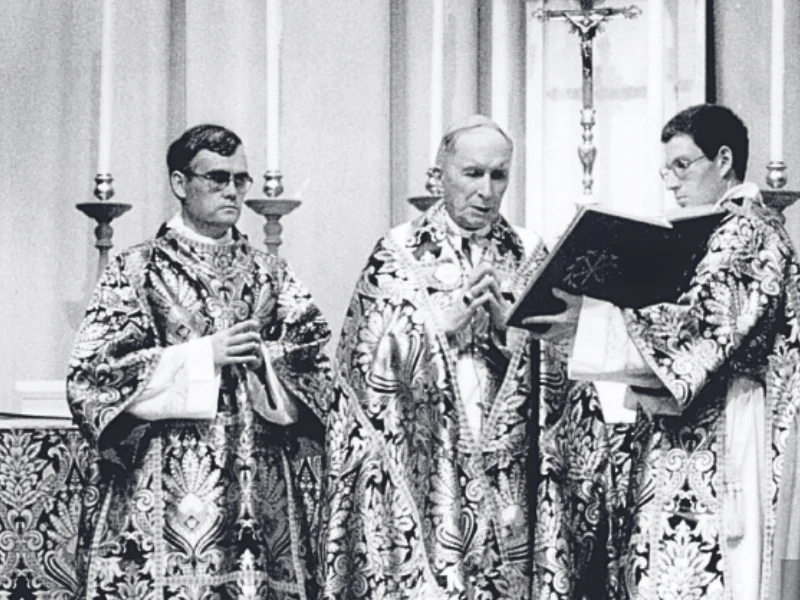
The following day, Saturday 14th of December, the blessing of the new church (which was to be replaced in later years by the much larger Saint Anthony’s church) took place at 9 am. This was followed by the Confirmation of 48 persons and Solemn High Mass which I served as subdeacon. On this occasion the Archbishop gave his sermon in English.


Afterwards, there was a large reception in the garden of the Smith’s house at which around 120 people were present. Once this was over, Mr Smith drove us to the Wanganui Aerodrome where there was a small four-seater plane waiting to take us back to Wellington.

This was a memorable journey for me as it was the first time that I had flown in such a small aircraft and I found the New Zealand countryside spread around us to be quite breathtakingly beautiful.
Australia
At Wellington we changed to another plane for Melbourne where we arrived around and 7 pm after another eventful and tiring day. We were driven directly to a hotel, the Brighton Savoy, to spend the night before another round of ceremonies which had been arranged for next morning.
On Sunday, 15th December, we left our hotel for the church at Hampton. This was a former Presbyterian Church which had just recently being purchased by the Society. Little did I realise then that this place would become my home 27 years later! At the time of writing, (2025) I have been in residence at Hampton for almost 13 years….


The ceremony followed the usual pattern – Blessing of the church, and Confirmation of 48 persons followed by Solemn High Mass. The Archbishop preached in English with similar content to previous Confirmation ceremonies.
Later on, refreshments were served and afterwards Father Hogan arranged for the Archbishop to sit before the altar in order that the congregation could come forward to kiss his ring. I have never witnessed such a ceremony before! Finally, all was concluded by Solemn Benediction of the Blessed Sacrament.


Later that afternoon Father Hogan took me on a tour of Melbourne city centre and we visited all the major public buildings. When we arrived at the Catholic cathedral, we discovered that an ecumenical Christmas Carol service was about to begin. There was a large congregation already assembled and we quickly took our places in the back pew of one of the side aisles as the procession entered.
Somewhat to our surprise, Archbishop Little appeared at the rear of the procession, wearing Mitre, Cope and Crozier, but strolling along rather casually and smiling at the congregation as if he were a public entertainer … As soon as he caught sight of us he gave a beaming smile and waved to us to indicate that we should join the procession! I took this to mean that he probably thought that we must be Anglicans discretely taking a back seat in the Catholic cathedral.
However, fortunately, the procession kept moving on without us, and in due course he took his place in front of his throne and joined in singing Oh come all ye faithful, while swinging from side to side with his mouth wide open…. When the hymn ended, he almost fell back into his modern comfortable throne and himself put his mitre back on his head in the most undignified manner imaginable.
After witnessing this spectacle, we quickly took our leave…
On the following day Monday, 16 December, Mr and Mrs Debrera drove me to a wildlife sanctuary at Healesville where I was fascinated to see the native wildlife of Australia. The Archbishop remained behind in Melbourne as there was a special lunch arranged for benefactors of the Society.
Next day, 17th December, we made an early start again, flying from Melbourne to Adelaide at 7:30 am. We were met there by Mr Wilkins and driven to his home. After a brief stay there, we then went to the Estonian Hall for Confirmation and Mass. Fourteen persons were confirmed and I estimated approximately 150 people were in the congregation.

The programme was much the same as previous events. I heard Confessions before the ceremony, but I did not serve the Mass or take part in the ceremony as there were enough servers present. The Mass was sung; but not very well. There seemed to be some disagreement about the music. During the recessional hymn a member of the congregation with a powerful voice tried to drown out the choir
by singing a different hymn in Spanish!
After the usual gathering and refreshments, we returned to the Wilkins house where we were joined by Brother Alban who was assistant to Father Cummins, a Redemptorist priest, who was then living in Perth. He, at that time, was the priest who was serving the Traditional Catholics in Adelaide, making the journey there regularly from Western Australia.
The Brother left us after the meal had ended. The part of Adelaide where we were staying was Brighton. The Archbishop and Father Hogan stayed at the Wilkins house, while I stayed with an old Irish lady, Mrs Herreen. Her dining room and kitchen were adorned with numerous pictures of the Royal Family. When I remarked (approvingly) about this, she assured me that it was quite appropriate as South Australia was still a Crown Colony!…
The following day, Wednesday 18th December, the Archbishop and Father Hogan flew to Perth to visit the congregation there which at that time, (as stated above), was being served by Father Cummins CSSR. I took another flight to Sydney where I was met by Father Esposito and Brother Joseph.


In the evening of the following day, the Archbishop and Father Hogan returned from Perth. Then Friday, 20th of December, was a day of rest and Father Hogan gave me a tour of the city. On Saturday, 21st of December, the day was spent at the house in Rockdale and a reception was held for various Mass Centre organisers and benefactors.
The following day, however, was the highlight of the visit to Sydney. The Archbishop celebrated High Mass in the Rockdale Town Hall which had been arranged for the ceremony. The choir sang very well, and the Procession entered the Hall to the sound of a fanfare of trumpets!! Later in the afternoon, the Archbishop gave a Conference, likewise in the Town Hall, during which he did not hesitate to make it clear that the destruction of the Church was being directed from the top – although he was careful to present this very diplomatically.

The following day he rested while I was taken on a tour of the Royal National Park, (a vast natural conservation area situated south of Sydney) as far as Helensburgh. This was the first time that I experienced the splendid pristine beaches of Australia and was highly impressed!

When we returned to Sydney that evening there was a great thunderstorm. This prompted the Archbishop to speak about the thunderstorms which he remembered from his days in Africa, and led on to discussion about some proposed visits to different parts of Asia, i.e. New Guinea, the Philippines, Hong Kong and Japan which the new Superior-General, Father Schmiderger, was envisaging that Father Esposito should undertake in the near future.
Christmas Eve was spent resting and preparing for the next day’s ceremonies. Father Esposito left to celebrate the Christmas Masses in Brisbane. The Archbishop celebrated the Midnight Mass and then even had sufficient stamina to celebrate his other two Low Masses immediately afterwards! Afterwards he joined Father Hogan and myself for a short celebratory drink. It was around 3am when Father Hogan left to drive to Newcastle (approximately 80 miles away) where he was due to celebrate Mass later in the morning.
I was awakened at about 6:30 am by someone tapping at my window. It was a neighbour from the next house to tell me that I must immediately ring a lay person, Mrs Pat Abdoo, for an important message. I had not heard the telephone ring as it was situated in another part of the house. On returning her call she told me that Father Hogan had had an accident and was in the Royal Newcastle Hospital. She intended to drive there immediately.
I celebrated the three public Masses for the parish in the morning. One of these was sung, during which the Archbishop assisted in choir.
Later in the day we discovered the details of the accident. It transpired that Father had fallen asleep at the wheel and ran into a telegraph pole while turning a corner. He had broken a foot and fractured his sternum and was in the intensive care unit at the Royal Newcastle Hospital.
The Archbishop, Brother Joseph and myself had lunch with Mr Carl Abdoo at his home and then, at around 5pm, I took a flight to Newcastle. This journey only took about half an hour. The plane landed at Belmont and I was met there by the Fren family who drove me to the hospital.
I was surprised to see that Father was in such a bad condition. He was on a respirator with a tube down his throat to help him breathe and another tube from his chest to remove the blood from his lungs. His body was bruised and his foot was in plaster. He was being fed by a
drip. His condition was clearly serious and, although I did not expect him to die imminently, I judged it safer to give him the Last Sacraments. He was quite conscious and able to communicate by writing. On conclusion of this visit Mrs Abdoo drove me back to Sydney.
The following morning Mr Abdoo called to discuss problems at the little school which had been established in the Church Hall at Rockdale. It was a very small enterprise with only one teacher, but unfortunately, she had given notice on Christmas Eve that she would be unable to continue in the new year.
This created something of a crisis and Mr Abdoo enquired if the Sisters of the Society would be able to save the situation. I was party to this conversation as I was acting as an interpreter. Later that day he and his wife called for me again and we drove back to Newcastle to visit Father who seemed to be much the same as the previous day.
We then drove back to Sydney. On Friday 27th of December the Archbishop flew to Brisbane to join Fr Esposito and visit our congregation there. This day passed uneventfully for me. Father Patrick Fox, a friend of the Society called in the evening and had supper with me. On the next day, the Abdoos again called to take me on a tour a tour of the city, including a ferry ride to Manly which provided splendid views of the magnificent Sydney Harbour.
On Sunday morning I celebrated Mass at 7am in a private house in Stanmore, a part of town near the city centre, before returning to Rockdale to celebrate Mass at the church there. I did not know why it was necessary to say Mass in two different locations so close to each other, but I supposed that this practice was a relic from the days before the church was purchased. In the evening the Archbishop and Father Esposito returned from Brisbane. That evening, over a drink, the Archbishop spoke about the problems of the school with me.
Next morning Mr Abdoo called again to discuss the school with the Archbishop. The latter thought that it might be possible for his son, Father Stephen Abdoo, recently ordained in the Society, to take responsibility for the school if his qualifications. were suitable. However, unfortunately, it transpired that he did not possess a Teaching Certificate. In due course, some time afterwards, the Sisters of the Society did, in fact, take over responsibility for the little school and this has continued until the present time.
Later that morning. Father Terence Hogan, a priest friendly to our Society came to visit the Archbishop.
On Tuesday, 31st of December I officiated at the funeral of Rita Lynch in the church at Rockdale with the interment at Rookwood Cemetery, which is situated a considerable distance away. After the burial, I spoke for the first time to a young man, her nephew, Shane Johnson. He would later enter the seminary and become a priest of the Society.
After lunch, later that day, the Archbishop mentioned that he was preparing a document about the Pope, (John Paul II) questioning if he really had truly the Catholic Faith, in view of all of the modern errors found in him. He elaborated this question at some length and said that, inevitably, he would be asked if he had the same assessment of Paul VI, but that it was not necessary to judge the past, but only to be concerned with the present and future. He also anticipated that people would no doubt say that he was posing such a question in order to justify the possible consecration of bishops; but that this was not the case…. I had never previously heard him speak of the Pope in such strong terms.
On New Year’s Day 1986, I once again celebrated Mass in the house at Stanmore before returning to Rockdale where the Archbishop celebrated a Sung Mass at 10:30 am. Later in the day, we received a call from the hospital in Newcastle informing us that Father Hogan would be transferred to Sydney the following morning. This was particularly welcome news as it meant that the Archbishop, who was by now very tired after the many previous hectic days, would not have to travel to Newcastle to visit Father Hogan before our imminent departure for
the United States.
Thursday, 2nd January, was our last day in Australia. Nothing particular happened in the morning but in the afternoon the Archbishop, Father Esposito and I went to visit Father Hogan who had been transferred to a small hospital situated conveniently close to our house at Rockdale. There we had the satisfaction of seeing him out of the Intensive Care and looking greatly improved after his accident. That evening we flew from Sydney Airport to America. A few lay people were at the airport to bid us farewell.

United States
We flew from Sydney to San Francisco via Honolulu. At this time the Archbishop continued to be much preoccupied with the question of the papacy and the implications of the consecration of bishops without, if necessary, the approval of the Vatican. Once again, therefore, the conversation turned to these subjects during this long flight. We examined the sedevacanist position fairly exhaustively and he asked my opinion about this subject.
I replied that my main reservation about this concerned the problem of the indefectibility and continuation of the Church and the election of a future Pope since, as far as one could ascertain, the entire hierarchy seemed united in agreement with the current trends in the Church. However, I said that, as far as the Society was concerned, I felt that if our present situation was justified it would be likewise justified to take the means necessary to continue it..
Once again, we spoke about the problem of the difficulties which could ensue in the event of dispute between bishops in the Society as well as what the duties of these bishops would be. The Archbishop seemed still to favour the idea of bishops who did not have any power of government in the Society but who would rather be consecrated only to administer the sacraments.
I repeated that, in my view, the episcopal power should be joined to that of the government of the Society, as otherwise conflict might likely arise. He replied that, in such a case, this would therefore mean that positions of authority in the Society would have to be for life; which he did not seem to think was a very good idea. He then pointed to himself as now being subject to authority in the Society since, no longer holding the position of Superior-General, he was only concerned with ordaining and giving the sacraments. I observed that this current situation was unique as, in the case of possible dispute with the Superior General, he could, as Founder, influence matters to such a degree that the former would be obliged to comply.
On the other hand, after the Archbishop’s demise, the Superior- General, if only a simple priest, might be in an impossible situation dealing with a recalcitrant bishop, as he would have no higher authority to which he could appeal.
When I pressed my opinion that I thought that, whatever happened, the Superior General would have to be a bishop, His Grace then said that he could be so, but not in virtue of his office but rather, perhaps, as a seminary Rector (!) He continued by saying that he had examined the idea of consecrating the Rectors of our seminaries to ordain priests and administer Confirmation which could be done during the seminary holidays…. Father Schmidberger, the Superior-General at that time, could perhaps be consecrated as Rector of the German seminary, a position which he could hold after his tenure as Superior- General came to an. end….
Looking back now, one can see that these conversations were cases of the Archbishop “thinking aloud”, but they are surely not without historical interest in view of all of the events relating to this matter which subsequently took place…
We were met at San Francisco by Father Laisney, then Superior of the Society in the United States, and two of our priests who were working in California, Fathers Finnegan and Post. We were driven to the Society’s house at Campbell, near San Jose, where we were to stay for a few days until the 7th January, when His Grace was due to return to Switzerland.
The Archbishop was expecting that he would now be able to spend a few quiet days, but when we arrived at the house, there were a great number of visitors, including several priests, and the place was a hive of activity. In addition, various events had been arranged which he did not seem to have been expecting.
Consequently, on Sunday the 5th January, the Archbishop gave a Conference at 9:30am in a public Hall at Campbell before Mass began. This was given in French and translated by me. It was followed by High Mass at which I served as deacon. The event was very successful and well attended, with four to five hundred people present.
The previous evening, we had been visited by a certain Bishop Mendez. The pretext for this visit seemed to be that a letter, which the Archbishop had written to him in 1977, had just come his attention. Apparently, it had been filed without the bishop having seen it; otherwise, he would have made contact before now! He and the Archbishop spoke privately for about an hour and he left at 9 pm.
Afterwards, His Grace remarked that this bishop did not seem to appreciate the gravity of the situation in the Church, although he had said that the Society must have Pontifical Right at all costs and that he would try to influence other bishops that he knew, in order to press for this outcome.
I heard nothing further about this bishop until very many years later, when it transpired that, shortly before his death, he had clandestinely consecrated a bishop, Father Clarence Kelly, who had been a prominent member of a group of nine American priests who had left our Society in 1983.
While we were at Campbell the Archbishop suggested that I go on alone to visit the Society’s school at Saint Mary’s, Kansas. I, therefore, took my leave of His Grace after the Mass on the 5th January and flew to Kansas. He returned to Europe alone on the 7th of January.


I was glad to be able to spend three days at Saint Mary’s. This vast complex of buildings was once a Jesuit seminary which had been acquired by the Society about seven years earlier. We had already established two schools there, for boys and girls, with approximately 180 pupils at that time, from infant classes to the highest level.
Fortunately, I was there when the pupils returned from their Christmas holidays and so I was able to see the school in operation. Indeed, I gave five classes in English Literature on one of the days — the teacher wished to make the most of the opportunity of my Scottish accent for the recitation and singing of works by Robert Burns! Most of the teachers were laymen who gave their services on a voluntary or semi-voluntary basis. At that time, there were three resident priests and a convent of four nuns.
I left Kansas City on the 9th of January and flew, via Chicago, to Montreal in Canada. On Sunday 12th January, I celebrated morning Mass in the Society’s Church in Montreal and another Mass in Ottawa in the evening.
Finally, I left Montreal in the evening of the 14th of January, arriving in London early the next morning.
Looking back on this journey forty years later, I am struck by how much things have changed and yet how much they remain the same. Our Society has greatly advanced in numbers, geographical extent and material prosperity. The “false Restoration” of Pope Benedict XVI has come and gone (although its residual effects have resulted in a more widespread celebration of the Traditional Liturgy throughout the Church, despite the recent attempt of Pope Francis to renew the persecution of former times), but the essential malaise of the Church remains the same.
Re-reading my account of this journey and my reflections upon it in my Newsletter of March 1986, to our Faithful in Great Britain on my return home, I find my words to be almost as relevant now, as they were then:
When this evil heresy of Modernism is finally driven from the Church it will be manifest that this will have been purely thanks to God’s mercy and not because of any human power. God seems to give us only the graces that we need in situations like this. He will give us all that we need to be faithful to Him, but not necessarily more. This is why I think that we have so few priests and only one bishop who is doing anything positive to maintain genuine Catholic Faith and Practice alive. I
t is nothing short of a miracle that His Grace the Archbishop, at eighty years of age, is able, at least occasionally, to visit every organised group of Traditional Catholics anywhere in the world, thanks to the easy means of communication and travel which would have been unthinkable just a few decades ago. Modern communications likewise make it possible for a single priest to carry on a very wide ministry which would have been quite impossible in past ages. Perhaps this is why God has allowed the present situation to come about.
Even in the worst persecutions of the Church in this country in the sixteenth and seventeenth centuries there were far, far more priests celebrating Mass in danger of their lives, than there are priests celebrating the Traditional Mass today.
Finally, I have been able to realise even more how important our Society is for these present times, and how much of a debt we owe to Archbishop Lefebvre. Our Society is, in fact, the only organised international group of Catholics, Clergy and Laity, who are doing anything positive about the state of the Church today.
The Society is not, of course, the Church, but it is most certainly OF the Church and must be an important, if not the most important, means of the Church’s eventual reconstruction. All its achievements are due solely to the faith of Archbishop Lefebvre. Without him there would be no Society, no young clergy and the Church’s traditional worship would now be all but extinct. Without this living witness to the Church’s Traditional Liturgy one can readily imagine that there would be no question of Indults or Permissions to celebrate Traditional Masses in any circumstances whatever.
by Fr. Edward Black, SSPX. Republished here with kind permission.
Click here to read about the first part of this trip, to Canada and the Americas.
Fr. Black was Superior of the Society of Saint Pius X in the United Kingdom from 1978 until 2000. As there were only five priests in Britain at any one time during those years, Fr. Black remained the constant factor amongst them and so makes a valuable contribution to the Society’s history through his memoirs.


Leave a Reply