
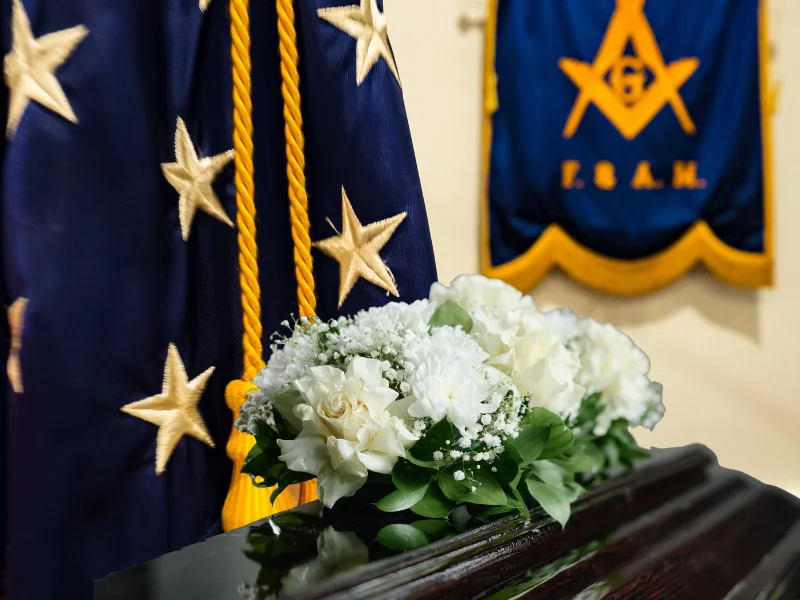
The topic of funerals for Catholic Freemasons has arisen again lately, with several high-profile cases coming out of in Europe. This article examines the issues involved in funerals for Masons, looking at what makes a funeral Catholic and also at the ambiguous statements from clerics who may be using semantics to cover their own tracks.
What makes a funeral Catholic?
Although it is typically part of a funeral service, Holy Mass has never been required for a Catholic funeral. Traditionally, Requiem Masses were actually forbidden on major feast days, Sundays, and during the Easter Triduum; this same prohibition applies to funeral Masses in the post-conciliar Church.
According to modern norms, for a funeral without Mass, a priest reads from Scripture and commends the spirit of the deceased to God. If this form of liturgy includes three vital components: the Vigil with its specific Catholic prayers; the Liturgy of the Word; and the Rite of Committal (the burial), then even without Mass, it is still a Catholic funeral. 1
Catholic funerals for Italian Freemasons
There have many numerous media reports of two controversial funerals of Catholic Freemasons recently conducted in Italy. One of those cases was the funeral of classical guitarist Bruno Battisti D’Amario, who was revealed to be a Freemason in a now-removed tribute from the Grande Oriente d’Italia.
The vicar general of the Diocese of Rome, Cardinal Baldassare Reina, intervened to deny “ecclesiastical rites” to D’Amario, allowing only a “brief prayer” to be performed in a church. Zenit reports that “a private religious service was held with the family in the presence of a priest, though without a liturgical celebration,” presumably referring to the Holy Sacrifice of the Mass.
However, as shown above, a Mass is not strictly necessary for a Catholic funeral and so if the “brief prayer” was accompanied by Scripture readings and followed by a Catholic burial, then the Freemason in question was potentially given a Catholic funeral after all.
In the second case, which happened only days later, Bishop Antonio Suetta of Ventimiglia-San Remo cancelled the scheduled Catholic funeral of a Mario Tarducci, a former “worshipful master” of a Grande Oriente d’Italia lodge.
Bishop Suetta in fact has just issued an entire document on the regulation of Catholic funerals, which “recalls who has the right to receive an ecclesiastical funeral and establishes provisions on the celebration of Mass, funeral eulogies, music, objects placed beside the coffin, cremation, and offerings given on the occasion of funerals.”

The 28-page document includes references to Canon 1184, which prohibits ecclesiastical funerals for “manifest sinners” and also refers to the 1983 Declaration from the DDF, which clarified that Freemasonry is “considered irreconcilable with the Church’s doctrine”.
Freemasons – more success in France
Another very high-profile case is that of the French politician, Senator François Patriat, which took place on August 25 in the Diocese of Dijon, France.
Patriat was widely known to be a Mason, was a friend of President Macron as well as a supporter of euthanasia. His funeral Mass was celebrated by Archbishop Antoine Hérouard of Dijon at the Collegiate Church of Notre-Dame in Semur-en-Auxois.
Although Zenit reports that the Archbishop “did not celebrate Mass in the strict sense,” but “simply presided over a ceremony without a Eucharistic celebration.” Yet this ritual again satisfies the requirements for a Catholic funeral if the special Vigil prayers were offered along with a Catholic burial afterwards.
In any case, a public ceremony by an Archbishop for a Freemason of Patriat’s stature, and held in a Catholic Church in the presence of President Emmanuel Macron and other Masons, remains a source of scandal, even if it was not technically a Catholic funeral.
The “Great Work” of the occult
A short video from the Vatican media outlet, Rome Reports, (below) mentions the two Italian cases, ending with a curious comment which gets to the heart of the ongoing lack of clarity over the status of Catholic Freemasons.
And yet here lies the paradox. A church that considers a Catholic membership in a lodge to be incompatible does not consider it impossible to establish a dialogue with Freemasonry – even despite its secrecy.
Taken at face value, this comment represents the “Synodal” approach to those mired in in error: “dialogue” rather than an attempt to evangelise the lost sheep.
However, it also reveals how, after almost one hundred years of unsuccessful attempts by Catholics to accomodate Freemasonry, a faction within the hierarchy remains undaunted, firmly committed to the cause of uniting light with darkness.
The process of uniting opposites is one of the basic principles of the occult world, frequently found in ancient mystery religions all the way down to modern witchcraft, as well as in Masonry.
This “Great Work” involves marrying light with darkness, male with female, good with evil, error with truth and so on.
By all accounts, there are forces within the Vatican dedicated, not to the defence of Christ’s Church, but to furthering the “Great Work” of occultism. The hierarchy’s ambivalent approach to Freemasonry is but one sign of those forces at work.

Leave a Reply