
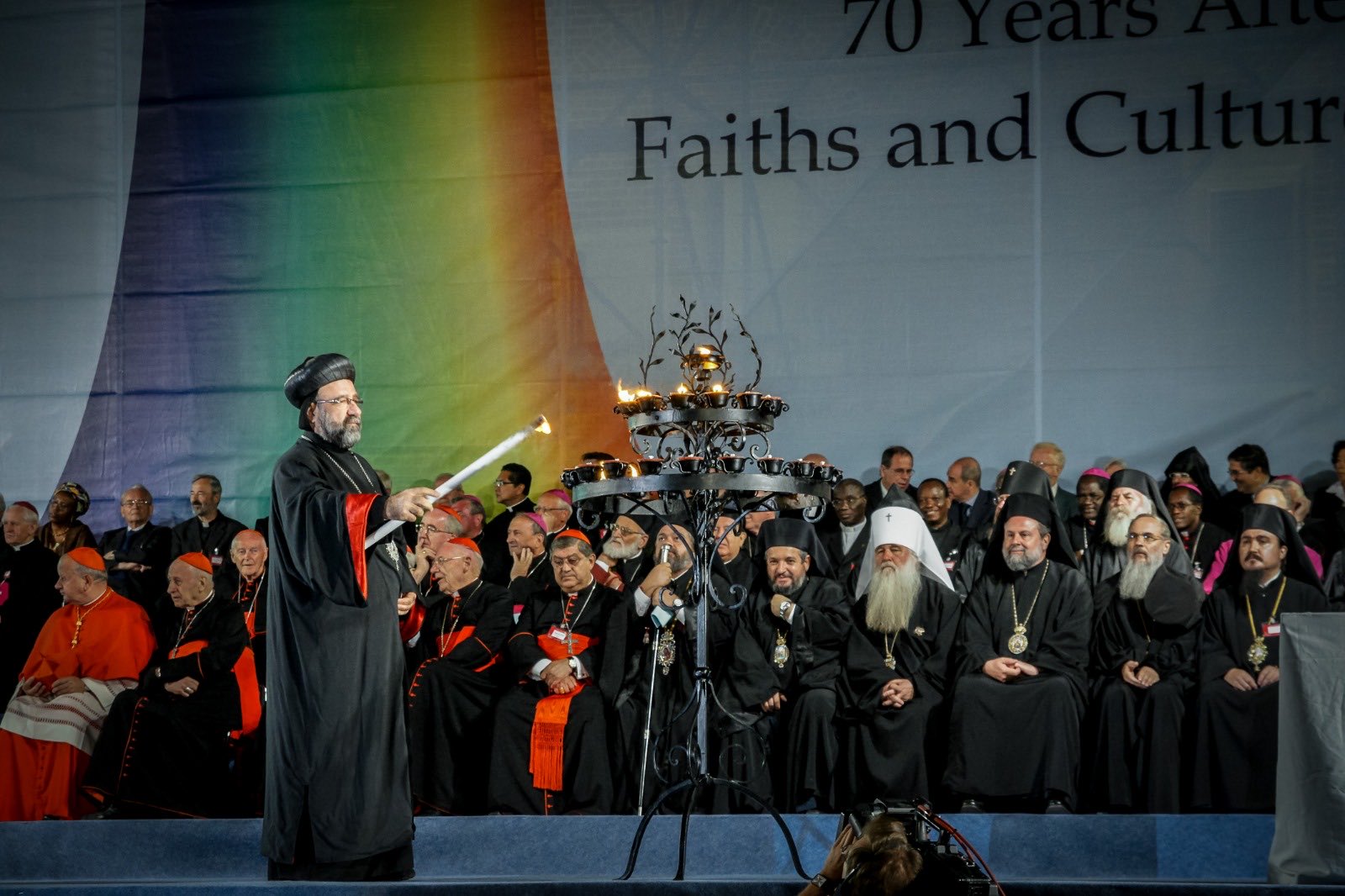
At the time of writing, an event to mark the 40th anniversary of John Paul II’s Assisi meetings is taking place at that location. Entitled, Unarmed and Disarming Peace, the three-day event runs from from October 25th to 27th and was to have featured a visit from Pope Leo, until he cancelled at the last minute due to his recent surgery.

The event is being organised by the Sant’Egidio Community, a group known for its commitment to spreading the “Spirit of Assisi” in Europe and elsewhere. The 2026 iteration of the Assisi meetings includes 384 representatives of various religions and cultures, hailing from 53 countries, while topics to be addressed include ‘conflict, disarmament, migration, poverty, young people, and the role of religions in building peace.’
The timing of the event is especially notable, since October 25th was the feast of Christ the King according to the traditional calendar. The feast day should be dedicated to advancing the reign of Christ the King on earth, which is the only sure way of establishing peace.
Instead, the Vatican is hosting a Babel of attendees, many of whom fail to recognise Jesus Christ as God, let alone as King of all nations. This chaotic attempt at achieving world peace by consorting with ‘the unfruitful works of darkness’ (Eph. 5:11) is therefore bound to fail.
“Unite spiritually”
In his Angelus address of October 25th, (10 min.12 s) Pope Leo referenced the Assisi meeting, asking the faithful to “unite spiritually with the representatives of the churches and religious leaders who will meet in Assisi…”, saying also, “May the Lord inspire choices of dialogue and peace.”
Yet, God would never answer such a prayer. Scripture is clear: “Wherefore, Go out from among them, and be ye separate, saith the Lord, and touch not the unclean thing” (2 Cor 6: 17).
Similarly, when it comes to praying with non-believers, there is nothing to be discerned; the teaching is explicit. St. Paul’s admonition seems as if the Apostle was present today, describing the Assisi meetings:
“Bear not the yoke with unbelievers. For what participation hath justice with injustice? Or what fellowship hath light and darkness? And what concord hath Christ with Belial? Or what part hath the faithful with the unbeliever? And what agreement hath the temple of God with idols? (2 Cor. 6:14, 15).

The ‘spirit of Vatican II’ is the ‘spirit of Assisi’
Which one studies conciliar documents such as Nostra Aetate and Dignitatis Humanae, it is clear that the the Second Vatican Council lends its justification to the Assisi meetings and other extreme ecumenical ventures.
In Phoenix from the Ashes, Henry Sire examines the grave responsibility for promoting error which can be attributed to Pope John Paul II for convening the original Assisi meetings, noting that it was the Pope himself who used the teachings of Vatican II to justify his events. Sire writes,
He, who had attended all the sessions of the Council, emphatically asserted that the meeting of Assisi was a fulfilment of the Council’s spirit. There we have it, then, from no less an interpretative source than a pope.
The meaning of the Second Vatican Council is that Catholics should encourage idolatrous worship and associate themselves with it in their prayers. If that is true, it is a far more serious indictment of the Council than any I have made hitherto.
The religious subjectivism implied in the Declaration on Religious Liberty 1 bears fruit in the syncretism of the Assisi meeting. The foundation of religion becomes not the God who reveals himself to man but the religious instinct of man, groping for faith, whatever its object may be.
Rotten fruits of Assisi
It is difficult to underestimate the effect the Assisi meetings have had on the Church; they have entrenched the novel idea that there is salvation outside the Church, leading to widespread violations of the First Commandment.
Many of Pope Francis’ most extreme actions, such as worshipping the pagan goddess Pachamama and signing the Abu Dhabi document in 2019 – the latter stated that “God wills the plurality of religions” – can be traced back to the actions of John Paul II.
Just this month, we have an example from the Archdiocese of Milan which a report states is offering online lessons on Buddhism to prepare young Catholics for World Youth Day 2027. Even worse, bishops in Italy are teaching school children that the Koran is the “revealed word of God.”

Another recent example comes from the UK, where this report states that Cardinal George Jacob Koovakad visited a Jain temple in Potters Bar, near London, on October 20, where he took part in a ‘devotional ritual’ in front of an idol.
Australia is not immune from examples of syncretism and even blatantly pagan influences in the Church. Last year in country Victoria, Bishop Shane McKinley allowed an occult-inspired artwork to be installed in his Cathedral.
The hideous figure, reminiscent of a Buddhist idol, sprouted five ‘flames’ which seemingly mocked the Five Wounds of Christ.

State of Necessity
John Paul II’s original meeting at Assisi in 1986 has long been put forward as evidence of the state of necessity which prompted the illicit consecrations by Archbishop Lefebvre two years later.
Indeed, the Archbishop once asked whether the Church can still be called ‘Catholic’ when it endorses an event such as the Assisi meetings. Due to the many sacrileges on display, the original event horrified any Catholic who still retained a semblance of tradition-mindedness.
The most egregious of the abuses involved a Buddha statue being placed on a tabernacle. Cardinal Oddi recounted:
On that day, I went to Assisi as the Pontifical Legate for the Basilica of St. Francis, and I saw true profanations in some places of prayer. I saw Buddhists dancing around the altar, on which they had put Buddha in the place of Christ, and they were burning incense to the Buddha and venerating it.
A Benedictine protested—he was thrown out by the police. I did not protest, but my heart was scandalized. Confusion was apparent on the faces of the Catholics who were attending the ceremony. I thought: if at this moment the Buddhists were to distribute bread consecrated to Buddha, these people would be capable of agreeing to eat it, perhaps with a greater devotion than when they receive the (Novus Ordo) host.

The pattern of clerics and laity being persecuted for defending the Church has not diminished, but rather, has accelerated during the past forty years. Traditional Catholics are now routinely being banned from pilgrimage sites, while sodomites and pagans are welcomed.
The Synodal Church of ‘dialogue’ and ‘openness’, ever willing to pray with apostates and idolators, remains intent on shutting the door of the inn to those guilty of nothing other than holding firm to the One, True Faith.
- See FSSPX.news, A Question of Doctrine: Religious Liberty According to Vatican II ↩︎


Leave a Reply