
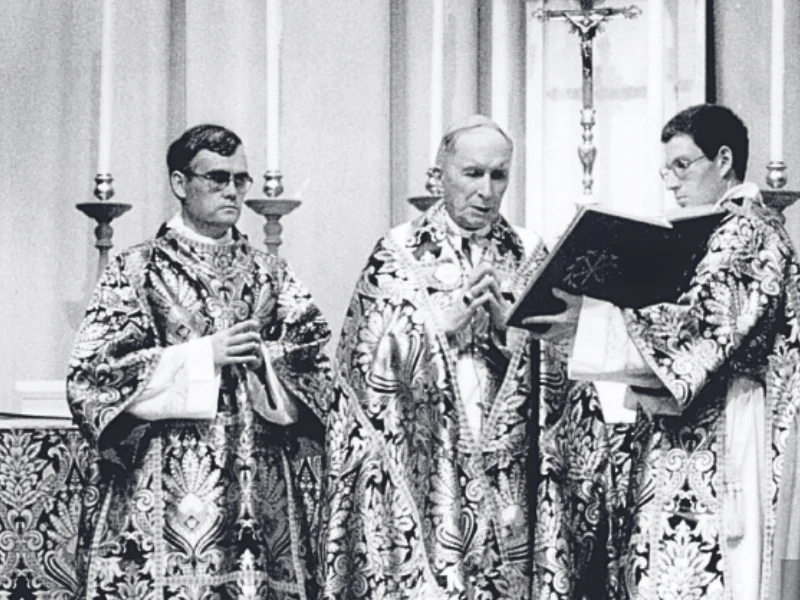
This extract from the book, Apologia Pro Marcel Lefebvre, by Michael Davies, is as true now as it was when it was written in 1979. It asks why Ecône was one of the few seminaries in the entire world (at the time, perhaps the only one) which adhered to directives of Vatican II regarding the formation of seminarians.
From The Condemnation: Chapter 5 of Apologia Pro Marcel Lefebvre, Volume I.
The injustice of the attack against Mgr. Lefebvre and Ecône is made very clear when some examination is made of precisely what is meant by a “rejection of the decisions of the Second Vatican Council.” I have provided considerable documentation in my book Pope John’s Council to prove that what are often passed off as decisions of the Council are, in fact, aberrations emanating from the post-conciliar commissions invested with the power to implement the conciliar documents. Only too often it will be found that not a single word can be quoted from any Council document authorizing these aberrations, which are justified by the commissions either on the grounds that the Council did not actually forbid them or by a very liberal interpretation of one of the ambiguous phrases which had been inserted in the documents precisely to justify such aberrations after the Council. In the Constitution on the Liturgy, for example, there is not a single word ordering the use of the vernacular. The celebration of Mass facing the people is not even mentioned. Nor does it anywhere recommend Communion in the hand, Lay Ministers of Communion, or the composition of new Canons. But the Constitution does specifically state that “there must be no innovations unless the good of the Church genuinely and certainly requires them.”
However, there were some specific instructions in the Constitution. For example, it was insisted that Gregorian chant should be “given pride of place in liturgical services. “

This instruction is obeyed in Ecône. But how many other seminaries obey it?
The same Constitution ordered that “in accordance with centuries-old tradition of the Latin rite, the Latin language is to be retained by clerics in reciting the Divine Office”.
This instruction is obeyed in Ecône. But how many other seminaries obey it?
The Council also ordered members of religious orders to wear their habit; it also recommended a year of spirituality at the commencement of seminary studies; it demanded that a key place should be given to the teaching of St. Thomas during seminary training.
Ecône obeys the Council faithfully in all these respects. But how many other seminaries do?
It is indeed no exaggeration to claim that the Holy See’s Basic Norms for Priestly Training, issued in 1970 along the lines suggested by Vatican II, are observed more faithfully at Ecône than at almost any other seminary in the West.
The fact of the matter is that there is not one hierarchy in the West which is making any attempt to enforce the teaching of Vatican II, even where this teaching is quite unequivocal and explicit.
As for the sudden concern on the part of the Secretariat of State for “the authority of Pope Paul VI” – where was this concern at the time of Humanae Vitae? It is worthwhile examining the statements of the Western Hierarchies and seeing just how many have honestly attempted to insist upon the clear and uncompromising condemnation of contraception demanded by the Pope. There were a few which did so in words (e.g., India, Ireland, and Scotland), but they were very few. And even in Ireland there has been a notorious refusal by Authority to discipline rebellious theologians and academic clerics who have continued to defy the Church’s authoritative teaching on marriage and the family with impunity.
It may also be asked how many hierarchies have attempted to enforce the Eucharistic teaching given by Pope Paul VI in Mysterium Fidei, or to insure that catechetics in Catholic schools are based on Pope Paul’s Credo of the People of God?
How many hierarchies take any action to discipline priests and institutions which do not simply ignore but even ridicule the authoritative teaching of the Holy Father? To ask such questions is also to answer them. It can thus be seen that the alleged respect for the decisions of Vatican II and for the authority of the Holy Father professed by Mgr. Mamie, the Commission of Cardinals, and the Secretariat of State is hypocrisy of the most blatant variety.
The true significance of the action taken against Ecône was given in an article by Edith Delamare in the French daily L’Aurore on 14 May 1975, in which she said:
The action taken by Rome against a flourishing Seminary, which is flourishing because it is traditional, is an historic act in the already two-centuries-old struggle between Liberal and conservative Catholicism.
In his Encyclical Pascendi Dominici Gregis, Saint Pius X, the Patron of Archbishop Lefebvre’s Society and Seminary, pointed out that the conserving force in the Church is Tradition and that Tradition is represented by religious authority. But the appalling seriousness of the present crisis can be gauged from the fact that religious authority is being used to suppress those who uphold Tradition, not those who have contempt for Tradition.
Saint Pius X wrote;
There is little reason to wonder that the Modernists vent all their bitterness and hatred on Catholics who zealously fight the battles of the Church. There is no species of insult which they do not heap upon them, but the usual course is to charge them with ignorance or obduracy.
That, alas, is what was being done by the Vatican Secretariat of State in the name of Pope Paul VI.


Leave a Reply