
.
Any measures taken against the SSPX and its ministry of the sacraments would be null and void. Not because nobody else has the faith, but because it is the main force in the Church today that embodies every aspect of Catholic doctrine without dissimulation: preventing that is the intention behind potential censures (and confirming latae sententiae penalties), and one that invalidates them.
The crisis is the Church is not an episode of Pope Francis’ papacy. Instead, as Bishop Athanasius Schneider said recently,
“ … since Vatican II, the popes up to Leo have unfortunately made certain affirmations, thanks be to God, not definitive, but ambiguous and difficult to reconcile with the clarity of the entire two thousand year tradition of the Church”. 1
The SSPXX exists because it cannot accept the conciliar orientation that is at odds with the magisterium of all time. The Ecclesia Dei movement, on the other hand, exists on the explicit condition that those benefiting from it will endorse every point of Vatican II, the entirety of its texts as interpreted by the post-conciliar Popes.
In practice, followers of the Ecclesia Dei movement pick and choose when it comes to the conciliar Popes. They have no choice; Pope John Paul II, who gave them their existence, led the scandalous gatherings at Assisi (for example) which they cannot profess approving. But picking and choosing is dangerous for traditional Catholicism.
The fact that a modernist like Peter Kwasniewski (who asserts that the Pope receives his jurisdiction from the assembled Church instead of Christ) can operate like a fish in water in these circles is proof of that.
The Conciliar Popes periodically scandalise Catholics and deny them clear doctrine on things about which all Catholics must be absolutely firm: other religions and Churches are not means to salvation; the Old Testament Covenant is null and void; Our Lord is King of all human societies and the Church should openly work towards all of them acknowledging this; for two generations, the Popes have not even enforced their own rules concerning the celebration of the Mass (this is quite apart from the doctrinal defects of the Novus Ordo text) – since Paul VI’s bloody-mindedness set the Church on its present course, it has been on autopilot.
SSPX – Most Roman of all
In practice, only the SSPX truly observes what Father Pagliarani said in his Declaration of Faith,
“The Roman Pontiff, the Vicar of Christ, is the sole possessor of supreme authority over the whole Church. He alone directly confers on the other members of the Catholic hierarchy jurisdiction over souls”.
On this point, the SSPX shows its indispensability in the Church’s recovery: it is the main defender of the papacy as established by Our Lord, the papacy that governs and teaches and which is the foundation of the Church on earth.
Noisy spokesmen for the Ecclesia Dei movement in English-speaking countries, like Kwasniewski, deny that bishops derive ordinary jurisdiction immediately from the Pope’s jurisdiction, as traditional magisterium has always taught. This sets the stage for a chaotic democratic Church of bishops and laity playing at parliamentary politics in Protestant fashion – a “high church” synodal way.
Kwasniewski, Sebastian Morello and Tim Flanders reject ordinary infallible papal magisterium (see High Church Modernism and the Loss of Faith), confusing it with ordinary non-infallible papal magisterium.
The result is that they now question or reject a huge body of pre-conciliar teaching (Kwasniewski says it’s all “up for grabs”). But according to Kwasniewski’s high church modernism, even Paul VI’s encyclical Humanae Vitae and John Paul II’s decree on the priesthood being reserved to men, are not infallible and would be potentially reformable.
Papal infallibility itself and Vatican I are questioned by Kwasniewski (he has incessantly plugged the heretical Virgilius/Kwasniewski Manifesto that seeks to overturn Vatican I and reduces the papacy to chairman of a committee of clergy who hire and fire the Pope).
Tim Flanders recently denied Ordinary Infallible papal Magisterium, affirming instead:
“ .. the Extraordinary and Universal Ordinary Magisterium (of all bishops) are the definitive criteria for including or excluding ordinary magisterium, not vice versa” 2
High church modernists are committed to this new doctrine because it means pre-Vatican II Ordinary Infallible papal teaching cannot be used as a basis to reject post-conciliar innovations. Secondly, it allows them to question all pre-conciliar Ordinary Infallible papal teaching; they have simply abolished this category. (For clear teaching on the three types of papal magisterium see “Clear ideas on the Pope’s infallible magisterium”.)
For Flanders and Kwasniewski, the conciliar Church has “gifted” laymen with the right to “self-refute” magisterium. Without that annoyingly precise and abundant Ordinary Infallible papal magisterium of the ages to guide us, it’s a free for all for modernists, high and low.
The Vatican won’t move on from the carnage
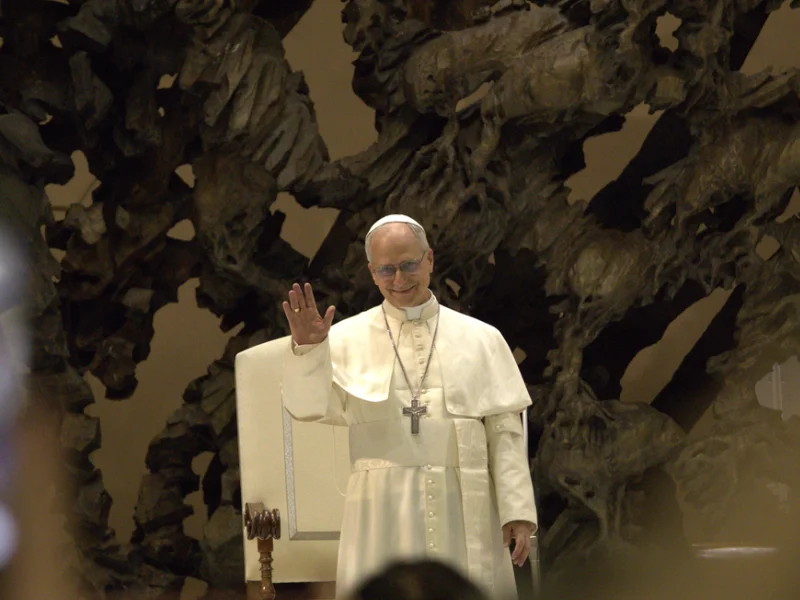
Pope Leo’s statement3 at Gastel Gandolfo that the core of the issue with the Society of Saint Pius X was several “points” in Vatican II documents, was a clear assessment, which some lay Ecclesia Dei spokesmen ignore by insisting that it’s all about ritualism.
The Vatican has been unwilling to show that these texts do not contradict previous teaching and simply asserts, as Pope Leo said: “sorry, but we’ve got to move on”; can’t stop to uphold non-binding Vatican II texts in the light of tradition, and asserts that traditional Catholics are rejecting “fundamental elements of the Church” by questioning those texts.
Unfortunately the Pope slipped back into the familiar Novus Ordo parish priest mode: an impassible repetition of “the Council says so. Next question”.
But this won’t work. The Church isn’t stabilising. It’s continuing to degrade quickly. The Pope will never renounce the faith, but this doesn’t prevent the Church’s continuing institutional decline. There is no cut off point, no end to the haemorrhage in sight as long as he refuses to “move on” from the letter and spirit of those “points” of Vatican II.
Without a strong voice saying ‘no’ to this direction, one that is able to forge new generations who will do the same, ending the crisis becomes much more difficult, with all that entails for souls. The Society’s new bishops are necessary, and a great grace for the Church.
By Vinicius. Vinicius is a Melbourne-based historian-researcher focussing on early modernity as the Christian Western alternative to ideological, Enlightenment modernity.
ENDNOTES
- “Bishop Schneider on Vatican II” – FSSPX.news ↩︎
- “A Magnanimus Note of Gratitude to Pope Leo XIV for Inserting Thomistic Architecture into Magnifica Humanitas” – onepeterfive.com ↩︎
- “The SSPX and the gates of hell “- PaxOrbis.org ↩︎


Leave a Reply