
by Joseph Bevan
All we want is to listen to Latin!
The ‘problem’ of the Tridentine Mass is going to be solved, one way or another. It has to be, for the obvious reason that the current chaos resulting from Traditiones Custodes is unsatisfactory to everyone. There is no doubt that the ancient rite of Mass divides dioceses, religious orders and parishes. It even internally divides individual clergy as they seek to say both the Novus Ordo and the Old Rite on the same Sunday, causing a type of schizophrenia.
It is now beyond dispute, and recognised by the Church authorities, that the Old Mass and the New Mass are incompatible as they represent contradictory religions. Were this not the case, then there would be no internal warfare within the Catholic Church.
In an interview on March 7, 2025, Cardinal Roche stated the following: “I often hear people say, ‘Cardinal Roche is against the Latin Mass.’ Well, if they only knew that I say the Mass in Latin because it is the common language for all of us here. It is the Novus Ordo Mass in Latin.”
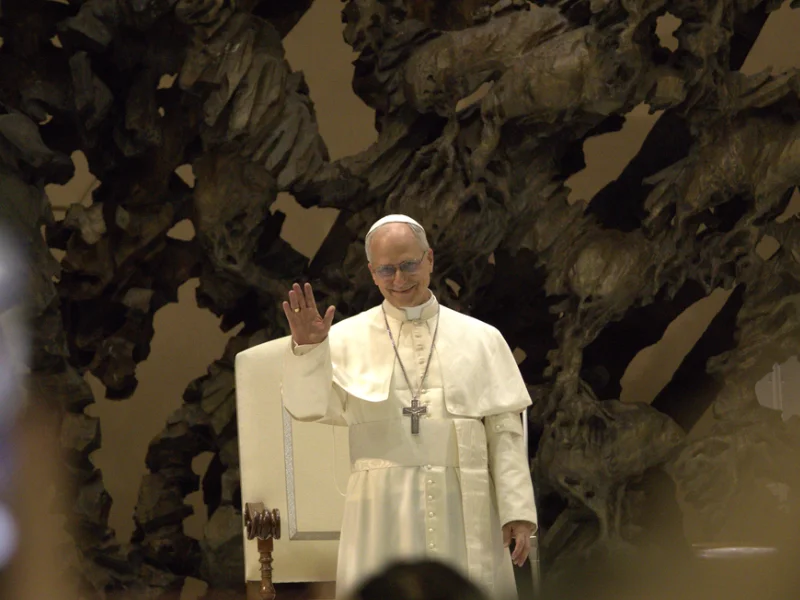
His Eminence’s words will strike a chill into the hearts of faithful Catholics who were hoping that Pope Leo XIV would loosen the restrictions imposed by Traditiones Custodes. After all, on the day of his election, did he not sing Latin? Did he not move back into the papal apartments? Did he not wear red socks? All these hopeful signs have come to nothing as the Holy Father himself said in a recent interview with Crux: “Well, you can say Mass in Latin right now. If it’s the Vatican II rite, there’s no problem.”
In order to remove any lingering doubt as to which way the wind is blowing, one needs only to read the following passage from Fr Carter’s statement to the parishioners of Knoxville, Tennessee, concerning his recent ban on the Traditional Mass: ‘The celebration of the 2002 Missal in Latin, with all the traditional options and elements already permitted in its rubrics, will ensure that the treasures of our tradition are preserved, while remaining in full communion with the Church.’
Avoiding polarisation
It is a fact that, whenever Rome has given permission to priests to celebrate the Traditional Mass, it has always been accompanied by the solid proviso that such celebrations should not in any way be interpreted as a rebellion against the Second Vatican Council (1962-1965) or its subsequent reforms. Also, a priest who says the Old Mass cannot abuse his permission by questioning the doctrinal veracity of the Novus Ordo Missae. By imposing these conditions, it is plain that the authorities wish to marginalise those who want the Old Mass, labelling them as liturgical junkies who are addicted to incense, plainsong and fiddleback chasubles.
One does not have to look very far, in the newsletters of the Latin Mass Society, for instance, to see how many of the Latin Mass adherents are happy to protest their attachment to Rome by insisting that they cannot be accused of questioning Vatican II and the liturgical reforms which resulted. In fairness to the LMS, I know many of its members who hotly condemn the Council and its reforms and even turn up to the Mass centres of the Society of St Pius X. Rome doesn’t care about these private opinions because all that matters is their official position, and that is the promise not to rock the boat.
Sadly, the same applies to the clergy attached to the Fraternity of St Peter, the Institute of Christ the King Sovereign Priest, and the Institute of the Good Shepherd, many of whom are privately ‘more Lefebvrist than Lefebvre’ but officially, they have run up the white flag. I have heard similar rebellious comments from the Oratorian fathers who, likewise, sometimes preach very risky sermons. Nothing happens, of course, because it is their official acquiescence which Rome has secured.
The chickens come home to roost
The attempt by the Latin Mass communities to have their cake and eat it – to say the Old Mass whilst maintaining obedience to Rome – has finally become intolerable to the authorities and they are now being asked to come clean. They may well be asked to switch to the Novus Ordo Latin Mass. How can they refuse? To do so would prove to Rome that they were not at all ‘sold’ on the reforms and were playing a double game. To go along with the new Latin Mass will demonstrate that they only had a purely romantic attachment to the old form, and little else. Many people may, tragically, give up religion altogether as the alternative, going to the SSPX, would be unthinkable considering their year in and year out insistence on loyalty to the Holy Father. It is not easy to break the habit of obedience to the Pope. Yes, people have even told me that they would rather abandon their faith than disobey the Pope.
Is there really a difference between the Latin Novus Ordo and the Tridentine Mass?
Rome says no! Occasionally, and from a practicalpoint of view, they are not wrong. When I visited London, I was a frequent visitor to the Oratory where they celebrate the Latin Novus Ordo as their main Sunday Mass. From my seat, about halfway down I listen to the beautiful music sung by a professional choir, I choke on incense and receive holy communion on the tongue. The celebrant faces east, and the vestments are ancient and beautiful. Brompton Oratory is often unkindly referred to as ‘the religious department of Harrods.’ Harrods is the expensive department store just down the road in Kensington. The sermon is delivered by a priest who speaks in a cutglass accent, mocking those who are of a liberal mind.
No doubt it is this kind of Mass which prompted Bishop Athanasius Schneider to remark recently that, provided the Novus Ordo was said or sung in Latin, layered with plainsong and incense, then there’s nothing wrong with it. That’s the point! If you go to Mass to be entertained, and are cultured, then this New Latin Mass ticks all the boxes and you will have no objection to the new reform.
I also remember the Latin Mass celebrated by Pope Benedict in Westminster Cathedral and was amused to observe the Pope’s concelebrators (yes, Novus Ordo Latin Masses can be concelebrations) struggling and tripping over the Latin words.
In real life, however, asking the average parish priest to celebrate a Latin Novus Ordo may meet with objections from him. The parish priest used to say the occasional Novus Ordo Latin Mass here, in Dover, which lasted no more than twenty minutes. A low Mass in Latin is very short indeed as the many of the prayers, like in the vernacular version, are deleted. Only one Confiteor, recited by the celebrant and the people together, likewise one Agnus Dei. Communion is often distributed in the hand as usual and the offertory is gone in a flash.
But, let us remind ourselves, we do not go to Mass to be entertained, and we must turn to doctrinal issues. When Cardinals Ottaviani and Bacci delivered their decisive and withering critique of the New Mass, it was the New Mass in Latin which they condemned in these terms: The Novus Ordo, “represents both as a whole, and in its details, a striking departure from the Catholic theology of the Mass as it was formulated in Session 22 of the Council of Trent”.
In a very instructive lecture given by Father Robinson in the United States, he stated that over 70% of the prayers of the Tridentine Mass were either deleted or altered so as to change their meaning, when introduced into the Novus Ordo. Those which remained untouched were regarded as sufficiently bland so as not to offend the protestants – the main motive behind the reforms of Archbishop Bugnini, according to his diaries.
But, one asks, if it’s all in Latin, then who cares? The answer is that the prayers of the Old Mass are mainly directed towards God, and the canon is recited in a whisper, also towards God. This emphasises the perfect sacrifice which is the true Mass and calls down abundant graces on those present. But with the priest facing the people and smacking out the prayers in Latin, it is even more likely that long-suffering Catholics will vote with their feet and abandon religion altogether as they are denied the supernatural benefits which are the hallmark of the ancient rite.
The Tridentine Rite contains all the truths of our Catholic religion. This is not so in the Novus Ordo, whether Latin or the vernacular, and this means that Catholics are denied the necessary graces which they need to save their souls. This explains the massive drop in Church attendance since the council. Wherever the Old Mass is restored, we witness a revival and a flowering of the faith as the decay goes into reverse and the explanation for this is largely supernatural, as most congregations are not Latin scholars.
I was asked by a Catholic journalist recently, who supports the Latin Novus Ordo idea, whether it would not be preferable to have the Novus Ordo in Latin, rather than the vernacular. My reply was that as they are equal in their insufficiency, I am repelled by them both.
Joseph Bevan. October 2025
Joseph Bevan has published: Two Families: A Memoir of English Life During and After the Council (Os Justi Press, 2024), available from the publisher or from Amazon. Further memoirs, entitled ‘Traddy Daddy’ are coming out in the Autumn.


Leave a Reply