
Dr. Peter Kwasniewski is a well-known North American writer on traditional Catholic liturgy. But he is also implacably committed to an esoteric religiosity that most traditional Catholics would be horrified by. Indeed twenty-five years ago, the esoteric, occultist version of traditional Catholicism that he and his network of writers have established barely existed. Yet traditional Catholicism was alive and well then, and a quarter of a century before that.
Esoteric, “High Church modernism” has not come from the traditionalist priests or faithful, but from networks of publishers like Angelico Press, who deliberately marketed occultist works alongside the most orthodox Catholic books in order to enter a “market” and proselytise it. It is only fair to people dismayed by the post-Vatican II crisis in the Church to inform them of how, under cover of opposition to one kind of change, an even more radical change is introduced.
It’s wrong to market occultism and heterodoxy under the banner of Our Lord, and it’s not uncharitable to say so. Peter Kwasniewski has long been aware of the disquiet his promotion of occultism is causing among Catholics. Rather than clarify his position, he has used statements, like the one discussed below, that only muddy the waters.
Like Father Hans Kung, who died a member of the Church, Kwasniewski is determined to remain inside it while distorting and reinventing it according to a “Hermetic tradition” supposedly present within and without all religious “traditions”. By marrying this to Catholic ritualism, a High Church Modernism results that is confusing but also seductive to some of the best Catholics. For threats to Catholicism don’t always arrive under easily recognised banners, like that of Jihad, or Calvinism. Sometimes the threat is fiercely determined to remain within the Church, like Jansenism and Modernism.
Kwasniewski’s simple strategy.
Occultism, esotericism, Guenon’s masonic “Traditionalism”, Kabbalism; all these things should be easy to spot, especially for traditional Catholics. How has Peter Kwasniewski’s close association with this world gone under the radar for so long?
Kwasniewski has moved in on the Anglophone market for material on the Tridentine versus post-Vatican II liturgical debate, on Gregorian Chant, etc. This large readership is then directed in no uncertain terms towards writers and organisations that express occultism explicitly, like Angelico Press, Roger Buck, Robert Lazu Kmita and Sebastian Morello. This has built up a large network of “Catholic” occultist “experts” centred around Kwasniewski.
Peter Kwasniewski voices esotericist views himself; his polemics about post-Vatican II liturgy are coupled with a deep attachment to an extreme modernist ecclesiology which came into vogue at the time of the Council (Part II of this article). He makes it clear that his whole idea of Catholicism is inseparable from occultism’s “Hermeticism”.

Tomberg’s Meditations on the Tarot.
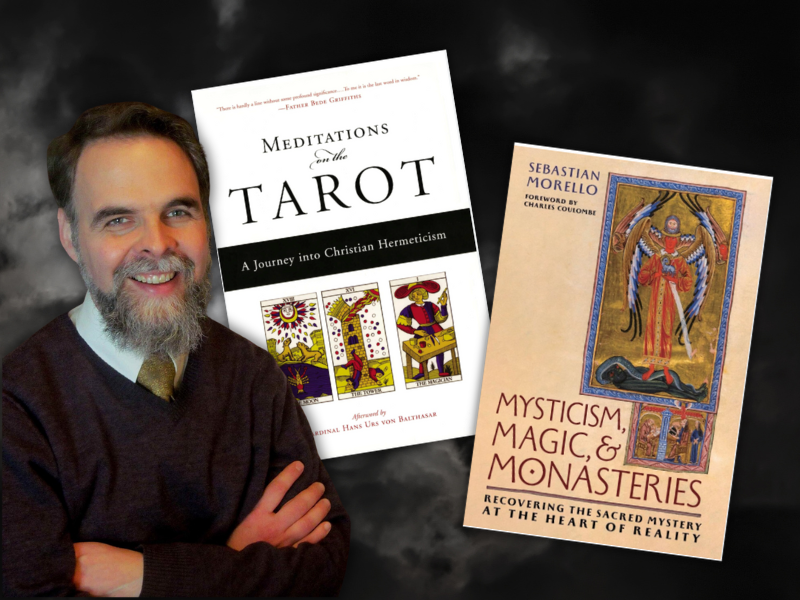
Kwasniewski’s notion of traditional Catholicism was heavily influenced by Valentin Tomberg’s (Russian-Estonian occultist 1900-1973) work Meditations on the Tarot (1980). Tomberg was initiated into Freemasonry in 1917 by the Russian Masonic leader Gregory Mebes. Mebes pioneered the synthesis of Kabbala and Tarot arcana on which Tomberg based his Meditations. What is Kwasniewski’s own account of his connection to this and how it made him a “traditionalist”?
Kwasniewski’s reverential treatment of Tomberg jars with the malignant swill (sometimes verging on satanism) exuding from each of Meditations’ 700 pages. In a letter (4/5/25 – the letter can be accessed here) to a Melbourne online Catholic bookseller, Kwasniewski says we need to “steal the gold” to be found in Tomberg’s work. He speaks with sentimentality of Tomberg merely stating that he “has his problems”, which he does not name or condemn. Kwasniewski situates himself (and the Church) in the context of a “good” “Hermeticism” or “magic” which cannot be easily discovered; “one should not look to the internet for wisdom”. These things are part of “a much older tradition, one that has ancient and medieval roots”.
Kwasniewski’s first thought is to rescue Tarot imagery, describing it as “medieval symbolic figures” (in fact, Tarot imagery dates from the Renaissance era of crisis for the Christian West); he says Tomberg then uses this superstition as the “point of departure for metaphysical and spiritual reflection”: “I read it back in college and it drew me closer not only to Our Lord, but also to Catholic Tradition. I know many others for whom it has exercised a similar apostolic function… Tomberg has played a remarkable role in bringing people to the truth… [though] I would seldom recommend his writings, nor would I reach for them at this point in my life, as I have found much better things to read, including Morello, who I think takes the best [from Tomberg]”.
Kwasniewski’s argument is that he and Morello are competent judges of what the Catholic Church would like to “steal” from Tomberg, comparing this witch to Aristotle and Plato. What follows is an examination of some of Tomberg’s “problems”.
Please excuse the length and toxicity of this material (Valentin Tomberg’s life and writings would have been far shorter if he had published a fraction of this in the Middle Ages, because he was not a Plato teaching pagans, but a “Catholic” trying to undermine the Church); Tomberg is the “bible” for the “High Church” modernism being constructed by Kwasniewski and his associates.
For Tomberg, devils are not enemies of God or men, and can become “friends” and “servants” of Christians:
Tomberg teaches,
“[the sign of the cross and] the formula ‘Let God arise, let his enemies be scattered’ does not apply, truth to tell, to entities of the hierarchies of the left [devils], because they are not enemies of God”. Tomberg refers to devils as “[celestial] hierarchies of the left”, “hierarchies of ‘strict justice’ as they are designated (with good reason) in the Cabbala”, or “natural demons”.1
Tomberg declares that prayers and signs of the cross are ineffective against devils, and that their target will only be left alone if he can “persuade” his demonic accuser or tempter that his charges are baseless: “one is righteous and “holy” only if good and evil agree that it is so”.2 Presumably the last judgement will be a trial by a heaven/hell jury.
“Sacred magic”, Tomberg asserts, effects “[devils’] transformation into Servants [of men] through their own accord by resistance to [their] temptations…Resist the devil, and the devil will be your friend… the act of sacred magic with respect to such a devil is that of reestablishing his faith in man”3; Peter Kwasniewski’s idea of “spiritual reflection” (his letter concerning Tomberg, above) is clearly different to that of the Church, which has always taught that devils hate humanity and seek to lead men to hell. But Tomberg says people should not “fear” devils.
For Tomberg, “Sacred magic” (Catholicism, apparently) exists to liberate the material world, men and devils, who all “hope ‘with eager longing’ to be “set free from its bondage to decay and obtain the glorious liberty of the children of God”4: not just humans, but cacti and devils will end up in the “Christian Hermeticist” Heaven.
Tomberg explains the reason for his soft spot for devils; there are “natural” ones (Satan and the “celestial hierarchies of the left”; to be respected as potential friends), and “humanly-engendered spirits”, which are much worse:
“Man… is far more dangerous than the devil and his legions… One has to guard against accusing [devils] to their detriment of having played the role of Molochs… [because] These are egregores, engendered by collective perversity, just as there exist “demons” and “evil spirits” engendered by individuals”
“They are, in other words, magical creations, for magic is the objectification of that which takes its origin in subjective consciousness [as Tomberg also refers to the Mass as “magic”, perhaps Peter Kwasniewski could enlighten us as to what he understands by the term]”.
Tomberg is quite clear: “The ‘demons’ or ‘evil spirits’ of the New Testament” are human creations, or “egregores”.5 Tomberg makes no secret here of rejecting Christian doctrine. Quoting another occultist, the Mason Eliphas Levi, Tomberg agreed that “The devil making magic which dictated… the exorcisms of the Ritual… inquisitors… the magic of sorcerers and of pious persons… [are] truly a thing to be condemned”.
Tomberg goes as far as to claim that exorcism, by “creating” devils, breaks the commandment against idols. As proof of this, Tomberg credits Tibetan Buddhism with creating demons and then “destroy[ing] them, to show that they are not worth fearing.6
Finally, Tomberg demands “silence” about devils:
“To be silent is more than to keep things secret; it is more even than to guard oneself from profaning the holy things to which a respectful silence is owed. To be silent is, above all, the great magical commandment of not engendering demons through our arbitrary will and imagination” 7
For Tomberg, the Catholic Church’s Exorcisms and harassment of witches break this rule of silence and profanes “holy things”. But enough of Hermeticist rubbish. The Church makes a lot of noise, praying (for example) after each Tridentine Mass, in the prayers for the Conversion of Russia, that devils should be cast into hell. The Church has always held devils to be eternal enemies of God and mankind.
It is astonishing that Kwasniewski claims that Tomberg helped lead him to Christ and traditional Catholicism. It is even more inexplicable that, as a Christian, he cannot bring himself to condemn it rather than say he has found even better authors to read, like Morello. Kwasniewski says he “seldom” recommends Tomberg right now (when did he stop recommending him more often?), but this only raises the question of who he could possibly recommend him to – a reforming orc?
One denial of Christian faith after the other.
Tomberg’s “problems” are not limited to viewing Satan as a “law-abiding” fellow sufferer and future inhabitant of Heaven who needs to be respected, and only wants to “find faith in men” by seeing them behave properly now. Christian faith is eliminated on every page by Tomberg’s heterodoxy.
Tomberg relativises and equivocates the significance of core Christian doctrines and terms:
“[One believes, if] one is a Christian, that Jesus Christ, the Son of God, inhabited this flesh8 and that he honoured it to the point of uniting himself with it in the Incarnation. Similarly, if one is a Buddhist or Brahmanist, one should not forget that Buddha and Krishna, also, inhabited this flesh”.
Tomberg believes that the human soul is evil, due to a previous existence before this world (he teaches reincarnation9), therefore Our Lord merely “inhabited” a body without a human soul.
This is not God’s taking up of human nature, as Christianity teaches. Nor is the Incarnation “similar” to the life of the founder of Buddhism, or to “Krishna”, obviously. Tomberg’s Hermeticism was not Christianity; how did Kwasniewski and “many others” find Christianity in it?
Religious syncretism is at the core of Tomberg’s work; a “mysticism” that consists in the “great work” of building a “tradition – the spiritual, Christian [why distinguish “spiritual” and “Christian”?] Hermetic, scientific tradition… the “great cathedral” of mankind’s spiritual tradition” Tomberg demands we be “respectful collaborators” of the occultists of the past, not daring to condemn them (their names are repeated literally hundreds of times in Meditations: Madame Blavatsky, Gerard Encausse, Éliphas Lévi, “Trismegistus”, Swami Vivekananda, Carl Jung, etc.).
Tradition for “Hermeticism” refers to all religions: “care for the rights and well-being of the poor is an integral part of the very essence of tradition – Christian, Jewish, Islamic, Buddhist, Hindu and humanist.”10 Tomberg defines hermeticism as “the way of experience of the reality of the spirit”, yet insists this is a “practice” beyond “religions”; he associates Catholic spirituality with “occult schools of every type and… ancient Hindu yoga”.11 In this way he can, without blushing, mix the names of occultists and Catholic saints.
Tomberg defends pagan gods (which are devils according to Christianity) as “real divinities”: “ ‘pagan’ initiates… saw in the practice of theurgy… intercourse with… celestial hierarchies… by rendering possible their descent and presence… in… temples”.
Tomberg quotes the anti-Christian Neo-Platonist Iamblichus: “such Gods are truly divinities”, and Tomberg supports him declaring that all of paganism was “renamed unjustly and calumniously as the ‘demoniacal religion’”.12 Tomberg preaches that Heaven and “Paradise” (the Garden of Eden) are the same thing: “Both the Hermetic treatises and the Bible state that the original sin was committed in heaven (Hermeticism) or paradise (the Bible)”, “The Fall occurred prior to the terrestrial life of mankind”.13
God is “dependent” on humanity.
For Tomberg, God is not Almighty. God cannot accomplish “miracles” without human input: “Resurrection is not an all-powerful divine act, but rather the effect of the meeting and union of divine love, hope and faith with human love, hope and faith”.14 Tomberg goes even further: God “cannot” act without uniting His will with that of men: “The meaning of this prayer [Pater Noster] is that God is powerful only in so far as his authority is freely recognised and accepted”.15
Similarly, guardian angels ignored by humans “fall into a state of… vegetation… “twilight existence… An Angel who has nothing to exist for is a tragedy in the spiritual world”.16 But for the Church, angels have the beatific vision. There is no tragedy in their existence.
Again, Tomberg makes the heavenly world dependent on human consciousness. This being the case, all “religion” depends on subjective human consciousness, not divine revelation:
“The four sacred truths of Buddhism were revealed in a sudden way, excluding all doubt, i.e. by way of inspiration. The great religions are therefore the inspirations of mankind”. 17
Tomberg freely reinvents the Faith: It was not God who spoke to Moses at Sinai, but Yahve-Elohim (whom Tomberg declares was only an “angel” 18).
Tomberg’s “mysticism” is purely natural, however: “Hermeticism has… has embraced for ever the law of “living life’ – the Cross – as its way, and resurrection as its ideal… It is a matter solely of the transmutation of the forces and faculties of human nature, i.e. the great work of human evolution [terms like “the Cross”, and “resurrection” are used with non-Christian meanings]”.
Not surprisingly “Hermeticism” rejects scholasticism because “Hermeticism has nothing to do with ‘ready made answers’ to all questions… Its “questions” are crises and the “answers” that it seeks are states of consciousness resulting from these crises”; “states of consciousness” are clearly preferred to religious dogma.19
Kwasniewski uses a different strategy with regard to Scholasticism, trying to reinvent it instead. Pre-Vatican II scholastic “manuals” are his main enemy however, because they had to deal with the false Mysticism alluded to by Pius XII in Mystici Corporis, the beginnings of the entry of Tomberg’s “Hermeticism” into the Church.
This was championed by Fr. De Lubac, and von Balthasar, who wrote a glowing preface for Meditations. These early High Church modernists founded the journal, Communio, in 1972, claiming to be inspired by the Fathers of the Church. But every fibre of Saint Thomas Aquinas and the Fathers lived in opposition to the errors of Tomberg’s “Christian Hermeticism” and no amount of reinvention by Kwasniewski can alter that.
Finally, Tomberg presents his “theory of everything”, a Hegelian synthesis that “explains” his accommodative attitude towards devils. For Tomberg, blasphemously, the Cross is the marriage of good and evil: “it is the “marriage of opposites” [“the alchemical principles”] and not their divorce which constitutes the basis of practical Hermeticism”. The same occurs with the “marriage” of human “lower nature” with the “true self”, “the result of which is an alchemical process of gradual approach to one another”.
“It is similar with the… [angels and devils] They can neither be united nor separated… [in an] alchemical process of the transmutation of evil into good… Divorce between the two sides would be an irreparable catastrophe”.20
Tomberg says the virtue of “hope invites us to believe in the final unity of opposites but also to work with a view to the realisation of this unity”.21 This is a radical rejection of the Catholic Faith. Every page of Tomberg’s Meditations contains heterodoxy. It would be fascinating if Peter Kwasiewski could spell out anything he got right, and how that lead him closer to Our Lord and Catholic tradition.
Kwasniewski’s promotion of Tomberg.
Kwasniewski writes little directly about Tomberg, but he unfailingly promotes every occultist Catholic that does. Kwasniewski doesn’t “reach for” Tomberg’s works now, but he does what he can to ensure that traditional Catholics do. His Substack refers readers with glowing praise to the website of Roger Buck, whose mission is the promotion of Tomberg’s works. He praises Angelico Press to the skies (while praising yet another Guenon-inspired esotericist, Jean Hani): “Angelico Press continues to build its empire as the premiere publisher of imaginative and intellectually rigorous traditional Catholic books”.22
But Angelico Press is the world’s premiere publisher of occultist “Catholic” literature, and its projected “empire” is the hearts and minds of traditional Catholics imbued with occultism. Angelico Press recently admitted to its lavish publication of Tomberg’s Meditations declaring, blasphemously: “Meditations on the Tarot shines with the light of a lifetime of contemplation enriched by the ever-nourishing sacramental life found in the Corpus mysticum”.
Under its sub-brand Sophia Perennis, Angelico Press declares: “We have tried to remain faithful to Traditionalist core principles – notably the Transcendent Unity of Religions”. To describe the occultists at Angelico Press as publishers of intellectually rigorous traditional Catholics books shows no respect for Catholics. Kwasniewski says he doesn’t often recommend Tomberg now, but he insists on feeding traditional Catholics to people that do little else. Peter Kwasniewski must wear Tomberg’s errors, whether or not he defends them openly.

Recently, Kwasniewski’s Os Justi publishing business put out a work by Sebastian Morello that is openly based on Tomberg’s Meditations (Mysticism, Magic and Monasteries, 2024). Kwasniewski (in his May 2025 letter) endorses Morello’s book as having taken the “best” of Tomberg. Mysticism and Magic therefore represents Kwasniewski’s personal view on Tomberg.
From cover to cover, the book cites Tomberg as the “spiritual” medicine for the Church. Unfortunately, Morello’s book, which Kwasniewski declares “develops” Tomberg in a more “orthodox way”, takes up the black core of Tomberg’s ideology. Morello doesn’t “steal gold”; he regurgitates Tomberg (almost unreadable) and makes his ideology more seductive for Catholics, but faithfully transmits its pervasive occultism.
Tomberg, like occultism and paganism, has an animist view of the world. Unlike Christianity, which has always clearly distinguished God from His creation, animism sees supernatural forces as emanating out of the material world itself. For Tomberg, the world is the prime means by which revelation takes place, but only to the “initiated”. For the Church on the other hand, revelation, properly speaking, is God speaking to mankind directly, or through prophets, the Apostles etc.
But Tomberg declares: “Hermeticism”, or the philosophy of sacred magic… wants to… [bring human nature] into harmony with nature… and render [it] capable of receiving its willingly bestowed revelation”.23 Morello, in another book (The World as God’s Icon), asserts that “seeing the world as ‘“God’s Icon” is “the shared vision of pre-modernity, and more generally the shared metaphysical vernacular of all broadly religious ontologies”.
According to this, to know the will of “God” all one has to do is to be in tune with nature, and pagan religions were able to do this through their animism. This is something very different from the respect for the material world as God’s creation that Saint John Damascene spoke of. But the “shared metaphysical vernacular of all broadly religious ontologies” was pagan darkness, ended once and for all by Our Lord and His word.
Mysticism and Magic (Ch. 4) laments that the world is no longer “enchanted”, i.e. that it lacks the animist, pagan understanding of the material world (the fault of the Catholic Church of the last 800 years as well the Enlightenment, he says), “any encounter with God [became] … considerably difficult, if not impossible”.
But how can Catholics agree that they have been barely able to “encounter God” in all this time? Morello’s assertion is as unchristian as his solution. Basing himself on Tomberg, he insists, “no sooner should the Hermetic vision be attained than it must be united to the Gospel proclamation and the sacramental power of the Church, otherwise it [the “magical tradition”] will rapidly degenerate”. This clearly states that “Hermeticism” is something outside the Church, but which the Church “needs” to be “united” to in order to be “saved”.
Morello insists, basing himself on Tomberg again: “to break the spell, the Church will have to turn once again to the Hermetic vision”; “creation truly conveys [God] as my speech truly conveys me”. Creation reveals God’s existence and reflects His glory, but hermetic animism is not the word of God; it is the imagination of men, at the very best.
Belittling Our Lady as a force of “nature” rather than Full of Grace.
Morello again quotes Tomberg at length, alleging that Meditations refers to Our Lady as “the principle of the virgin”. Morello’s connection is blasphemous because Tomberg’s “principle” is not Our Lady and does not concern the Annunciation, grace, or the supernatural: Instead, Tomberg asserts, “Free Nature has therefore accomplished her task [“by giving birth to the divine Word”]. She has surpassed herself, and since then the epoch of the supernatural – the epoch of divine magic – has begun. Natural religion is now flooded in the radiance of supernatural religion… the new evolution”. This is outrageous; the religion of the Old Testament was not any kind of “natural religion”, which has never existed.
Tomberg’s “virgin principle” is nature, devoid of grace and the supernatural, a practitioner of “natural religion”.24 Indeed, the “supernatural” for all these occultists is very secular. For Morello, “the Kingdom of God and the City of God can be found nowhere but in the heart of man [Monasteries, Magic, Ch. 4]”; not in Heaven, apparently.
Morello’s “black magic of modernity” will be overcome by the “sacred magic” of the occultist legend “Trismegistus”, and “the unchaining of the Church may begin and its supernatural gifts be delivered once more”. This is a rejection of the Economy of Salvation and of Grace, which cannot be chained, much less “unchained” by “magical” practices clearly described by Tomberg as naturalistic. Morello’s idea of mysticism is truly unwholesome, describing (Ch. 10) “True Benedictine charism” as “the near-psychoactive meditations of the Sibyl of the Rhine…[or] Abbot Johannes Trithemius’ practical angelology of incubatory spellcasting [placed on the Index Librorum Prohibitorum]”.
A “Catholic occultist” strategy?
Kwasniewski and Morello’s book betrays the outline of “hermetic Christian” strategy: “Had you seen an early Franciscan, you likely would have struggled to tell him apart from a Waldensian, a Bogomil, or an Albigensian. They… shared similar aspirations”, [but practiced] “unswerving loyalty to Christian orthodoxy and the institutional structures of the Church. This, though, was a loyalty that they maintained while simultaneously enlarging the parameters of what was then deemed orthodoxy”. Today “our response must be an expansion of the parameters of orthodoxy whilst remaining steadfastly loyal to the ancient Faith and the Church”.
Early Franciscans loyal to Saint Francis did not “aspire” to heresies, as Morello maintains, but the Jansenists and Modernists certainly did employ the strategy Morello brazenly suggests: stay inside the Church and change its beliefs. Curiously, Kwasniewski has regularly published on the necessity of remaining inside the Catholic Church, while being obviously unhappy with the Church as it has existed for the last 600 years, much further back than the Enlightenment.
Kwasniewski and Morello’s Monasteries and Magic asserts that for hundreds of years, Catholics have been “under a spell, and that spell must be broken. Perhaps the sacred magic of Hermes Trismegistus is what’s needed to banish the black magic of Enlightened man”.

Trismegistus was a synthesis of the pagan Greek god Hermes and the Egyptian god Thoth, and is the legendary author of the Hermetica, the fifteenth-century occultist ramblings that these High Church occultists think the Church needs to ward off its “hex”. Morello also repeats Tomberg’s heretical doctrine about humans “creating” devils25, suggesting more occultism to ward them away.
In his letter on Tomberg, Kwasniewski recommends Jean Borella’s book on Gnosis, claiming it is inspired by the Fathers of the Church and opposes Gnosticism. The Society of Saint Pius X published a work some years ago (prefaced by Bishop Tissier de Mallerais) entitled The Gnostic Heresies of Professor Jean Borella26, which tells the truth about this dangerous gnostic now in fashion in some conservative Catholic circles.
Morello and Kwasniewski (Monasteries, Magic, Ch. 10) assert that the Church, the Body of Christ is not whole, not unified, and lacks “its greatest treasure”: “the western Church will never rediscover its greatest treasure, namely its monastic charism, and so free itself from the yoke of clericalism, if it does not heal itself and become with the Orthodox one Church”.
So Christ’s Church is just the “Western Church”, without “monastic charism” for the last thousand years, and suffering from the “clericalism” of what Tomberg calls the “Church of Peter”? Just about every heterodox movement (Lutheranism, Jansenism, modernism, etc.) has claimed to be returning to the Church’s roots, and High Church modernism is no exception.
Conclusion
Tomberg outlines his vision of the future; the end of the Church as Catholics have always known it. This is the key to Peter Kwasniewski’s anti-Roman reinvention (which he says is inspired by the Second Vatican Council) of the Church (see Part II of this article): “They [Christian Hermeticists] do not [intend] to replace the existing religions… they possess.. the communal soul of religion”.
Tomberg preaches “the end – more or less at hand – of the church of Peter, or above all of the papacy which is its visible symbol, and that the spirit of John… will replace it…. the “exoteric” church of Peter will make way for the “esoteric” church of John”; “The mission of John is to keep the life and soul of the Church alive until the Second Coming of the Lord… He vivifies this body, but he does not direct its actions”.27
For Tomberg and his followers, the Church of “Peter” is merely a matter of government and “rational” dogmatic “propositions”. The “spirit” they hope will come to “vivify” this body is occultism. Fortunately, the Church can’t become the zombie awaited by these occultists, but this subversive ideology warrants more attention from traditional Catholics, who are its first target.
Kwasniewski and Morello claim that Tomberg is the point of departure for an integration of “hermeticism” (occultism) and Catholicism. But Tomberg says explicitly from the outset that the two things are different: “He who is searching here [in “Christian hermeticism”] for the ‘true religion’… is looking in the wrong direction”.28
In truth, “Hermeticism” is the antithesis of Christianity, and a renaissance of paganism. It seeks to keep the exterior forms (especially the ritualism) of Catholicism, but “possess” them, reinventing the meaning of our rituals and doctrinal terminology, occupying the very space Catholics stand on. Kwasniewski and Morello’s “hermeticism” is “High Church”, which is bad news for traditional Catholics: a network of occultists wants to inhabit their rites, terminology, buildings and language.
The next section examines how they finish the job by taking away the Fathers of the Church, Saint Thomas Aquinas, the constitution of the Church itself, reinventing them all in the light of occultism.
By Vinicius. Vinicius is a Melbourne-based historian-researcher focussing on early modernity as the Christian Western alternative to ideological, Enlightenment modernity.
- Valentin Tomberg, Meditations on the Tarot. A Journey into Christian Hermeticism, Penguin, New York 1985, pp. 456-457. ↩︎
- Tomberg, Meditations, p. 459 ↩︎
- Tomberg, Meditations, p. 73 ↩︎
- Tomberg, Meditations, p. 72 ↩︎
- Tomberg, Meditations, pp. 71, 437 ↩︎
- Tomberg, Meditations, pp. 437-439 ↩︎
- Tomberg, Meditations, p. 442 ↩︎
- Tomberg, Meditations, p. 469 ↩︎
- Tomberg, Meditations, p. 471 ↩︎
- Tomberg, Meditations, pp. 442-443 ↩︎
- Tomberg, Meditations, p. 15 ↩︎
- Tomberg, Meditations, pp. 461-463 ↩︎
- Tomberg, Meditations, pp. 468, 469, 472. This identification of the Garden of Eden with Heaven has been preached obsessively by a columnist of The Remnant, an occultist associate of Kwasniewski named Robert Lazu Kmita. Kmita teaches that humans can return to “heaven” through meditation. ↩︎
- Tomberg, Meditations, p. 616 ↩︎
- Tomberg, Meditations, p. 90 ↩︎
- Tomberg, Meditations, p. 410 ↩︎
- Tomberg, Meditations, p. 428 ↩︎
- Tomberg, Meditations, p. 412 ↩︎
- Tomberg, Meditations, p. 489 ↩︎
- Tomberg, Meditations, p. 491 ↩︎
- Tomberg, Meditations, p. 509 ↩︎
- https://www.newliturgicalmovement.org/2016/09/three-fascinating-new-books-from.html ↩︎
- Tomberg, Meditations, p. 78 ↩︎
- Tomberg, Meditations on the Tarot, p. 297 ↩︎
- https://europeanconservative.com/articles/essay/incarnation-and-egregore-two-principles-in-opposition/ ↩︎
- Full text available online, in French ↩︎
- Tomberg, Meditations, p. 13-14 ↩︎
- Tomberg, Meditations, p. 12 ↩︎





Leave a Reply to Jeff MCancel reply