
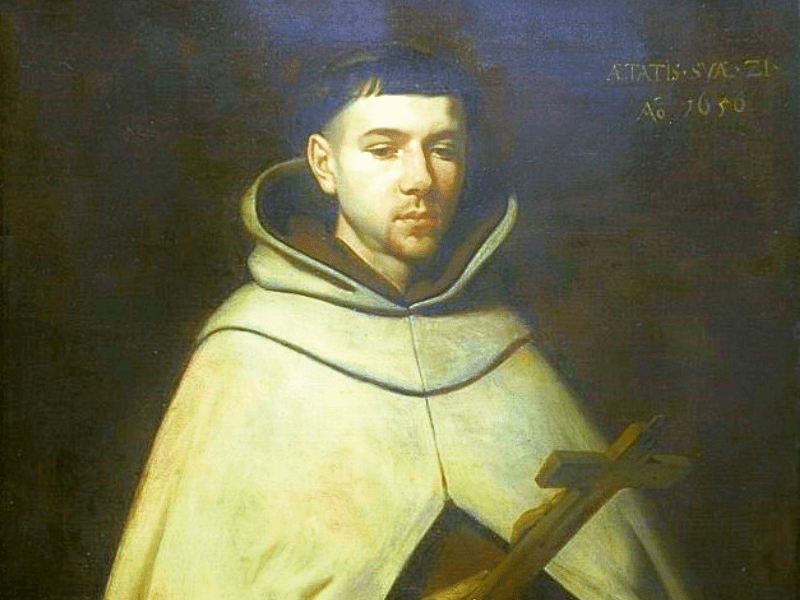
Fr. Opie was one of Australia’s early ‘Hero Priests’: this account of his thoughts on the Novus Ordo Missae come from Catholic and are republished here with permission.
The following came to the Editor of Catholic as a letter from Mr F J Loughnan of Chirnside Park, Victoria, who had known Father Opie for many years. Some of the emphasis was in the original, some was added. What we have here, added to what Archbishop Little said of him in his sermon at the Requiem Mass, only adds to the stature of this most remarkable priest who was Father James Opie.
Fr F. Laisney, Superior of the Society of St. Pius X in Australia at the time, was also intrigued by what Fr Opie wrote all those years ago, and he wrote his impressions for Catholic. The substantial text of the panegyric preached by His Grace, Archbishop Little at the Traditional Requiem Mass for the repose of the soul of Father James Opie was published in Catholic for January 1992.
In the introduction it was suggested that “It is doubtful if he even accepted the validity of the vernacular Novus Ordo…” To his credit, Archbishop Little gave a very unbiased account of the life of Fr Opie, and of his ‘difficulties’ with, as Archbishop Little put it, the “new visions of Church Traditions.”
In 1978, the late Fr Opie responded to a person who had published a defence of the New Mass; he provided Mr Loughnan with a copy of it. The contents printed below is of interest, for it gives a penetrating insight into not only his ‘difficulty’, but also his acumen and great wit. The text has been edited to protect the recipient’s identity, and we can be sure that Fr Opie, now we pray, in the presence of his and our Most Blessed Lord, has had his grave doubts resolved.1
Father Opie began by making four statements:
Introduction
1. I consider the Novus Ordo Missae in Latin is valid. I use it every week. The matter, form and intention (my own) are the same as in the Tridentine Mass.
2. I consider the Novus Ordo in English is invalid through defect of form.
3. I consider the Novus Ordo in Latin contains some statements that are heretical or what is worse proximate (haeresi proximo) or offensive to Catholic ears.
4. The Novus Ordo in English has many more such heresies—one on every page! Even the title page!
You did not introduce numbers 3 and 4 into your ‘defence’ and I do not intend, therefore, to intrude them into this discussion. However, I must mention them to show the logic of my case.

A parable: You are an Algebra teacher. A new text-book is provided. In looking through it, you notice some improvements but you find that the book teaches, e.g., that x multiplied by x = 2x or that b(a-b) = a. I suggest that you can either discard the book altogether or use it, making sure to change the howlers or omit them when they turn up. You would have to adopt the second alternative if the Education Authorities insisted on its use.
Similarly, Archbishop Lefebvre (who teaches with authority, as belonging to the Ecclesia docens2 has chosen the first alternative.
I, since my Bishops have prescribed the Novus Ordo and I belong to the Ecclesia docta3, must choose the second alternative.
However, no Pope nor Bishop can compel me to sin, i.e., simulate a false Mass or promulgate heresy. I make, therefore, the necessary changes in the Novus Ordo. I can see no absence of logic in this. My arguments are surely sound, the premises may be false but not the logic. (Incidentally, I have not said the Tridentine rite of Mass since two days before the Novus Ordo was imposed. Incidentally again, my preference would be for the Tridentine rite with Introits and Communion verses (for the most part) from the Novus Ordo and using the Novus Ordo Lectionary, with the Judeo-Masonic bit removed; also a simplification of the Tridentine rubrics and ceremonies, partly along the lines of the Novus Ordo.
(Note by F.J.L.: Upon his retirement Father Opie was able to say, as Archbishop Little put it at his Requiem Mass, “his beloved Mass in Latin . . . for others who had formed a similar conscience . . . But now note what follows:)
It remains for me now to present a realistic defence of my claim that the Novus Ordo Mass in English is invalid because of defective form.

1. Let me make this point. I do not have to prove that the Novus Ordo English form for the wine is invalid. I only have to prove that there are solidly probable reasons for suspecting invalidity. If so, then pars tutior est sequenda4 and this was affirmed by Pope Innocent XI. The situation is vital.
You will readily recall the urgent Baptism case. In the bottle near the bedside there is a liquid. It might be lemonade, it might be methylated spirit (to rub the patient’s back), it might be water. I must not say ‘it might be water; it will do’. I pick up the empty glass and get what is certainly water from the bathroom tap. Similarly, the Novus Ordo form might be valid or might be invalid. Pars tutior est sequenda. Now, what solidly probable doubts exist regarding the English form?
2. You argue that ‘This is the cup of my blood’ is sufficient. I suggest the following grave doubts:
a. The Church frequently states that the longer statement (i.e. of the new and eternal . . .) is part of the form, e.g. Council of Florence. The Church constantly states or presumes that the form is essential to a valid Sacrament. Ambiguity among some theologians regarding what is essential and what is of the substance makes no difference. The grave doubt remains.
b. The Church constantly teaches that the Sacrament effects what it signifies and must signify what it effects. The short form signifies only a Real Presence, not a Sacramental Sacrifice. The grave doubt remains.
3. The English form has been changed from the Traditional, e.g. ‘enim‘ omitted, ‘mysterium fidei‘ omitted, ‘for many’ to ‘for all men’ and ‘in remissionem etc.’ to ‘so that sins may be forgiven.’
But just listen: ‘No one (of early Church writers) ever disputed that Baptism and the Eucharist were instituted by Christ in person and in the form from which the Church must never recede’! ‘The Apostles . . . acted on some sort of mandate from Christ in person: precisely in what way He gave it, save in the case of Baptism and the Eucharist, we cannot ever know’. (Both excerpts from The Sacramental System, Fr C.C. Martindale, S.J.)
I hasten to say that I do not wish to prove something on the authority of a famous theologian. We all know from the second Vatican (so-called) Council what harm can be done to the Church by famous theologians. I quote Fr Martindale to show how easily he takes for granted as recognized Catholic teaching that there can be no change in Baptism and the Eucharist forms.
Add to this Pope Pius XII: ‘Ecclesiae nulla competat(it) potestas in substantiam Sacramentorum id est in quae, testibus divinae revelationis fontibus, ipse Christus Dominus in signo sacramentali servanda statuit.5 The sacraments that Pope Pius XII refers to, have always been considered as Baptism and the Eucharist. Even as late as Pope Paul VI — he speaks of the ‘verba dominica’6 and quotes the long form! I suggest the grave doubt remains. You change the verba domenica at your peril.

4. So it is ‘for all men’! The Son of God, despite infinite knowledge, was not able to express Himself and left His infallible Church in error for eighteen centuries or more and did not mind making a fool of the Roman Catechism compilers, St Thomas Aquinas and others, who have tried to explain why it is ‘for many’ and not ‘for all’. How can you believe in a Divine Christ and an infallible Church like that? But my claim is much more humble: Grave doubts remain.
5. ‘For you and for all men’ — is the Son of God now providing us with the most juicy example of tautology in the English language? I prefer to safeguard Our Lord’s being relegated to Grade VI by claiming: Grave doubts remain. To suggest that the verba Dominica have such a tautology is blasphemous.
6. ‘For all men’. You go to much trouble to assure your readers that Christ ‘died for all men’. More precisely—and you yearn to be precise, I know—you should say that nobody has been excluded from redemption won by the death of Christ on Mt. Calvary about 783 A.U.C.7 if he keeps to the rules. These rules are (among others) believing and being baptised, as Our Lord said. I do not think you claim that ‘all men’ have believed and have been baptised. How can the Mass be of any value to the others? In other words, the Mass is for ‘many’, not all men.
7. ‘For all men’. The Mass is the Sacrifice of the Mystical Body of Christ (I think there is no need for me to prove that). Do you mean then that since the Mass is ‘for all men’, all men belong to the Mystical Body? Or do you mean that—even if they do not offer—‘all men’ share Christ’s victimhood, although many have never heard of Christ on the Cross? Or do you mean that any Mass may be offered for any human being (all men therefore). But I can offer Mass for the preservation of my crops, for the cure of my dog from distemper. Are my crops and my dog members of the Mystical Body? I suggest grave doubts remain.
8. ‘For all men’. You are insisting (very correctly) on the universality of Christ’s Redemption on Mt. Calvary about 783 A.U.C. certainly less than 24 hours after He used these words of Consecration. But when He used these words—the Verba Dominica, we have always been told—He was not dying on the Cross, He was instituting the Sacrifice and the Sacrament of the Blessed Eucharist. Since He knew that this Sacrifice and Sacrament were going to be futile for so many, how could He say ‘all men’? Do you mean that though He knew the Mass (the Eucharist) was going to do nothing for millions, He still insisted that the Mass formula must state ‘for all men’?

9. ‘It will be shed for you and for all men’. (Also, of course, ‘My Body, which will be given up for you’). In the new Mass the Body is given up for (presumably) the Apostles, but the Blood is shed for the Apostles and all men. Quite a complicated business. St Thomas does very wonderfully explain why ‘quod pro vobis tradetur‘ is not part of the form. Perhaps you and Paul VI, etc. should go back to your texts.
10. ‘It will be shed’ (also, of course, ‘will be given up for you’). These are the verba Dominica. Do you think that Our Lord did not understand the future tense? We have already seen that the Infinite Logos was a bit weak in grammar. Perhaps I shall now have to put Him ‘back into Grade III’.
‘The Blood will be shed’. Now you say that ‘for all men’ refers to Christ’s Sacrificial death. Surely, ‘the blood will be shed’ must refer must therefore refer to also— it is the very same sentence as ‘for all men’ — to Christ’s Sacrificial death. Our Lord knew that these ‘Verba Dominica‘ would be ignored by the Apostles to beyond the time of His death. How could He use a future word that would never be used correctly?
I suggest that Our Lord was not speaking of His His actual death but of the Mass. The Blood will be (Sacramentally) shed, in this new Rite that He is instituting at the Last Supper for the Apostles (you) and for many.
‘For all’ would be an absurdity with respect to the Mass. The future tense is essential for all Masses right up to the last Mass at the end of time.
I prefer to promote the Divine Logos for His grammatical knowledge and suggest to you that grave doubt still remains with regard to your English translation. Of course, you may prefer to get the six Protestant advisers to change the English text — the ICEL experts would be happy to oblige — to ‘It (the Blood) has been shed about the 783 A.U.C.’. Grave doubts remain.
11. ‘So that sins may be forgiven’. This is supposed to translate ‘in remisionem peccatorum‘. Now, ‘in remissionem peccatorum‘. is the totality of the New Testament, something incredible to the Jews, stating a de facto state of forgiveness as a result of redemption. The key word is into (in = accusative; eis in the Greek) which tells us that as a consequence of the Sacramental shedding of blood, we are brought into the state, where we can be forgiven.

Now what does the English leave us with? A purpose clause, subordinate clause! A purpose clause states why a thing is done and abstracts from whether it is actually done (e.g. I trained hard (purpose) so that I may win the race. Result — I came last). Do you think that this sacramental form signifies what is supposed to effect, namely the remission of sins? I suggest there are grave doubts.
Conclusion
What then do I do? I do what any fool would do—make sure, or as it is put more elegantly, ‘pars tutior est sequenda‘. It takes no more than ten seconds to achieve.
But now, of course, it takes much humility on the part of those priests who have defended the doubtful over many years. In detail, I say the words of Consecration (if they are) in English, aloud. Then immediately I repeat them secreto in Latin. I have thought of omitting the words in English altogether. I have some misgivings about this.
Not being a member of the Ecclesia docens, I cannot publicly state ‘this form is invalid’. I know that Pope Paul’s English is little better than that of Amenhotep IV but my Bishop must be presumed to have a thorough knowledge of English, including future tenses. etc., etc.
In your ‘Defence’ you would include me among those ‘after having fooled the people’. I reply:
(a) this is not true for me because I have carefully explained to my people what I do
(b) ‘Fooling the people’ regarding the repeating of the form in Latin would never be as serious as fooling them by simulating Mass and distributing bread to them in a sacrilegious communion.
Just one final point. You … emphasise this ‘faith in Pope Paul’, mentioned more than once. I have been a Catholic a long time and this is the first time I have heard such an expression from a supposedly Catholic pen.
Faith is a divine virtue by which we believe the truths which the Holy Catholic Church believes and teaches. Now Pope Paul VI is not the Holy Catholic Church. His task is to safeguard these truths, which he may or may not do.
If he defines infallibly Novus Ordo, I shall beat even you in proclaiming my Credo. Otherwise, it is a merely human, fallible statement. Pope Paul has not had the guts to command us to accept it. (I use it because my Bishop commands me) I am grateful Pope Paul has not commanded me. It is not pleasant to have to disobey a Pope, if he commands me to use a book of Divine Worship, containing heresies.
Here ends the extract from Father Opie’s response.
Footnotes
- Father Opie notes the mistranslation of the words of Consecration “Pro Multis” as being “For all men”. This error appeared in nearly every vernacular translation of the Novus Ordo Missae. The error went on for many years until the translation was finally corrected. ↩︎
- Ecclesia docens — the teaching Church — those who have authority to teach in the Church ↩︎
- Ecclesia docta — the taught Church — those whose duly it is to receive the teaching of the Church ↩︎
- pars tutior est sequenda — the safest path must be followed ↩︎
- Pope Pius XII, Ecclesiae nulla etc: “The Church has no power in the substance of the Sacrament, that is, in those things which, according to the testimony of the Sources of Revelation, Christ the Lord Himself has established to be observed in the sacramental sign.” ↩︎
- Verba Dominica — “Sunday” words – the words of the Lord ↩︎
- Ab Urbe Condita — from the foundation of the city [of Rome]: this was the way of counting the years in the Roman Empire ↩︎


.jpg)


Leave a Reply