
Archbishop Marcel Lefebvre uttered those words 38 years ago, when asked about the possibility of illicit episcopal consecrations by the Society of St. Pius X.
Today, the two remaining Bishops of the Society of Saint Pius X are facing the same dilemma that Archbishop Lefebvre faced nearly 40 years ago, as so far, there is no indication that Rome will grant permission for consecrations to be held in the near future.

The following is an English translation of a 1987 interview in which journalists from the Italian journal Trenta Giorni asked Archbishop Lefebvre about his intentions. It was first published by the Australian traditionalist publication, Catholic, in July 1987, Issue #55 and is reproduced here with permission. It is prefaced with its original introduction by the editors of Catholic.
In this article, you will learn the mind of the Archbishop as he contemplated objective disobedience to the Pope and potential excommunication, for the sake of the Church’s highest law: the salvation of souls.

Pax Orbis prays that the current bishops of the Society will be guided by the Holy Ghost as they navigate their flock through this critical juncture.
Introduction from Catholic
The Italian Review Trenta Giorni (Thirty Days) recently published an interview with His Grace Archbishop Lefebvre by Messrs Stefano Paci and Lucio Brunelli at Écône, Switzerland. His Grace told us “I received them for two hours on two days and I replied in a lengthy manner to their questions” Our translation of the interview is taken from Fideliter, the Society’s French publication, by kind permission of its Editor, the Very Reverend Paul Aulangier.
The two journalists in question did their ground work well, and did not fear to question His Grace even on the most burning questions of the day. And contrary to many others, Archbishop Lefebvre did not back away from answering. His replies as you will see, were direct, to the point, precise and categorical. Indeed nothing will make him renounce the defence of the Faith, of the Catholic Religion and of the Church. Albeit that he did not choose it, he prefers to remain in opprobrium rather than give in to cowardice. He prefers to die a Catholic than to give in to error. He wishes to render an account of his episcopate in all fidelity to Our Lord Jesus Christ. Once a Missionary, he has chosen to continue such witness all his life in spite of the persecutions. Nothing can trouble the peace that rests with him in his choice and in his heart.

Interview begins:
30 G. Your Grace, your last public declaration is a violent act of accusation against the Prayer Meeting at Assisi…. Are you not confounding the ecumenism of Pope Wojtyla with the deformed ideology of inter-religious dialogue – so much in vogue during these past years – which denies the historical uniqueness of Christian Salvation?
Arch. L. I see only one type of ecumenism: that which which the Council promoted, which underlines the respect and collaboration with false religions, all placed on the same for a footing. It is a new conception, and a contradiction with Tradition, which was thus ignored. In place of a ‘missionary’ Church, there appeared the new ‘ecumenical’ Church. The Meeting at Assisi consecrated this new Church, and that is an enormous scandal.
On the other hand this happening had a significant precedent: almost a century ago in 1894, at Chicago there was held a spectacular Congress of World Religions at which the American Catholic Bishops assisted.
If you place side by side the addresses of those bishops with the address of the Pope to the Cardinals last December on “the spirit of Assisi”, one can see some powerful analogies. However, a century ago, Pope Leo XIII condemned without reserve, the participation of the United States Bishops at the Chicago Congress.
No, it is a scandal, a public blasphemy; think of the Catholic Missionaries in Africa who saw on television the representative of the Animist Religion, praying at Assisi at the invitation of the Pope…
In what spirit could they continue the hard work of evangelisation amongst the populations who follow these pagan rites? If salvation is still possible without conversion to Christ in the Church, while still continuing to adore false gods, what sense remains to the Missions? All religions are then equal, and good …
If this Pope had lived in the times of the Roman persecutions in the first centuries perhaps Christianity would have found a respectable place at the Pantheon of religions.
30 G. You outline a caricature of the Pope’s ecumenism! John-Paul II has never said that all religions are ordinary means of salvation. Even at Assisi he unequivocally proclaimed the certitude that Christ alone saves and leads the natural religious sense to a good end.
Arch. L. Granted the position of the Pope is not one of pure liberalism, according to which all religions are equal – However, let us speak for a moment of liberal catholicism which gives pride of place to conscience and thereby renders subjective the truth which it nevertheless professes.
You may not agree, but if you attentively examine the protocol followed at Assisi, one sees how the ‘philosophy’ was inspired to put all the religious represented on the level of absolute equality.
One could object that the Pope was seated at the centre of the guests, however I am sure that when he goes to Tokyo, on the occasion of the next Prayer Meeting, nc longer being master of the house, he will not occupy a special or pre-eminent place. He will be one amongst many.

30 G. Nevertheless, when you left the audience of November 18, 1978, the tone of your declaration was much different. “I have confidence”, you said, “that with John-Paul II all will be possible”. To what do you attribute your change of attitude?
Arch. L. I had been struck by a section of his talk in which he affirmed that the Council should be read in the light of Tradition. At Last! I said to myself one can hope for a revision of Vatican II. But my wait was disappointed.
Who knows, perhaps it was men of the Curia who put obstacles to his advancing on that road. Everyone knows that in the Vatican there is an influential Liberal-Masonic Mafia without whose ‘placet’ no change is possible whatsoever. Thus has the actual moment arrived in the Church where one celebrates the triumph of liberalism?
30 G. Since that audience you have not met the Pope in private?
Arch. L. No, I have had but ‘official’ contacts with Cardinal Ratzinger, Cardinal Oddi and Cardinal Gagnon. On a more ‘officious’ level I have had meetings with the Frenchman Jean Guitton who showed himself to be very interested in my ‘case’.
30 G. Undoubtedly in the course of these discussions you have spoken of eventual solutions to your ‘case’. Could you elaborate please?
Arch. L. The Holy See would be disposed to ‘regularize’ the existence of our work, the “Priestly Society of Saint Pius X” from which ecclesiastical approbation originally given on November 1, 1970, was withdrawn in 1975; a decision I hold invalid according to law.
We were told that the Pope would be quite ready to erect the Society into a Personal Prelature. We would have amongst other things, the authorization already foreseen by the Indult of 1984, to celebrate Mass according to the old Rite of St. Pius V. All, upon condition however, that we would subscribe to a declaration of full acceptance of the Decree and reforms of Vatican II. But in conscience that is impossible for us.
30 G. On January 29, 1979, you declared with satisfaction to a Swiss newspaper, “The Pope himself said to me that it would suffice for my part, a declaration in which I would say I would accept the Council according to Tradition”. An agreement then seemed possible, or are we that mistaken?

Arch. L. Even Cardinal Ratzinger, when he was named Prefect of the former Holy Office thought our case could be resolved in some months. But one must be honest. The phrase that you have cited could be interpreted in diverse ways.
What does it signify – “to accept the Council according to Tradition”? We spoke about it several times the precisely with Cardinal Ratzinger; for him, that meant that the theses of Vatican II would have to be integrated into those of Tradition.
But, “to integrate”, is a verb that is still vague. To my mind it would be better to distinguish it. It is evident that there are some conciliar texts conformed to Tradition which pose no problems. I am thinking of Lumen Gentium, as well as other documents, as for example, those on priestly formation and on seminaries.
Then there follow ambiguous texts which nevertheless could, in a certain manner, be correctly ‘interpreted’ according to the preceding Magisterium (Teaching). But there are also (Council) texts which are plainly in contradiction with Tradition; which in no way could be possible to ‘integrate’ them; the Declaration on Religious Liberty, the Decree on Ecumenism, that of the Liturgy. Here agreement becomes impossible.
30 G. However, as far as we know you voted in favour of the Decree on the Liturgy …
Arch L. I celebrated Mass according to the new Liturgical directives of 1965, but never according to the definitive Directives of 1968 which carry the signature of the then Monsignor Bugnini. In any case it is the Declaration on Religious Liberty which is the true apple of discord, because the introduction of this liberal principle into the Church flows from other errors.
The rupture with Tradition in this case is evident; eleven Popes from Pius VI to Pius XII have condemned Liberalism, the Council approved it. No one can convince me that a contradiction does not exist. During the course of the audience I had at Castel Gandolfo in September 1976, when I posed the question to Paul VI, he replied to me, “We haven’t got time to speak of theology”. As if it involved a purely academic question!
30 G. And Cardinal Ratzinger, what reply did he give you?
Arch. L. The Prefect of the Congregation for the Doctrine of the Faith asked me to place in writing my opinions and my doubts on this theme. This I did, and in November 1985 I sent him my study of 150 typewritten pages.
In January 1986 he replied to me that he had received these documents, and that he appreciated the philological care taken with its preparation. We know that the Holy See asked all the Episcopal Conferences to send to Rome a study on the theme of Religious Liberty, and that the French Bishops have already sent their contribution.
The Jesuit Father who was its author wrote: “It is tragic that all the Popes of the 19th century did not understand the Christian truth which is to be found in the principles of the French Revolution”. You can see there is a rupture, and what a rupture!

To revise Vatican II
30 G. Given these preliminaries, the only solution to the Lefebvre ‘case’ that you would accept, seems to be a that meant that public disavowal of Vatican II by the Sovereign Pontiff.
But, let me ask, could you see the Pope, one Sunday morning, appearing in St. Peter’s Square and announcing to the Faithful that after more than 20 years, he is advised that the Council was wrong, and that at least two Decrees must be abolished; decrees voted by a majority of Council Fathers and approved by a Pope.
Arch. L. Right, off we go… At Rome, they would be able to find a more discreet way …. The Pope could affirm with authority that some texts of Vatican II need to be better interpreted under the light of Tradition, to the degree that it would be necessary to change some phrases, in order to render them more conformable to the Magisterium of preceding Popes.
It would have to be said more clearly that error can only be ‘tolerated’, and that it can never have ‘rights’; and that the State, neutral on the religious plane, cannot nor must not exist… However, of course, I am not deluding myself: even if the Pope wished to bring about these corrections he would not be able to do so. This ‘liberal-Masonic mafia’, to which I have already made allusion, could not tolerate it.

30 G. You have a certain penchant for seeing ‘plots’ more or less everywhere. Five days before being struck with your suspension ‘a divinis’, writing to Paul VI you had denounced “a secret deal between high church dignitaries and Freemasons, established even before the Council … “
Arch. L. But all the American newspapers wrote that, before the Council, Cardinal Bea, founder of the Vatican Secretariat for Ecumenism, met at the Hotel Astoria in New York, the heads of the most influential Judeo-Masonic Lodge, and asked them what they hoped from the Council. “A Declaration on Religious Liberty”, they replied.
30 G. Several times you have qualified as defenders of “The Christian Order” personages such as Franco, Salazar, and now Pinochet. Are dictatorial regimes then the only possible means of handing down ‘the Catholic State’?
Arch. L. Let us take Pinochet. I don’t say that his regime is a perfect one, but at least we find Christian principles for the fundamental program of his political orientation. He is a man of justice and order, and he favours the presence of the Catholic Church, even if the Chilean Bishops – Oh what a paradox! – are not in the least grateful to him.
It seems that the Chilean Bishops would wish for their country a new Allende (former Communist dictator). Thank goodness the Catholic people do not follow their bishops on this point.
A month ago I went to Santiago, to inaugurate the opening of one of our churches. I believe that the faithful would follow us en masse if we had sufficient priests, they are so fed up with the attitude of their hierarchy!
Recently when Pinochet escaped an assassination attempt, great public demonstrations of solidarity with, and affection for Pinochet took place in the capital. Many of them had a spontaneous religious character. The people cried out “Thank you, O Most Holy Virgin, for protecting the life of the General”.
30 G. Could you give a broad outline of the extension of your work throughout the world?
Arch. L. We are operating in 28 nations on all the Continents, except for Asia, albeit that we hope to found a house in India. We maintain five seminaries, about ninety houses, several schools, and at Paris, a University Institute. Two hundred priests and fifty religious are effective members of our Society. But a much bigger number of priests and nuns, without being members, work with or alongside our Order.

An isolation in appearance only
30 G. Considering your growing isolation in the Church, does any doubt well up within you?
Arch. L. Our isolation is more apparent than real. Numerous bishops, and at least ten Cardinals have privately said to me that they partake of our positions. I could reveal their names if necessary. We know for example, that a certain number of Cardinals were not in agreement with the Meeting at Assisi, and revealed their reservations to the Pope.
Above all, however, we feel no isolation regarding the part, regarding Tradition. Indeed we are made strong by the words and the Magisterium of the Church which has preceded us.
30 G. Recently two cases of defections in your ranks have had a discreet echo in public opinion: the six young seminarians of Écône, and the monastery of Father Joly at Flavigny. How do you explain these?
Arch. L. The seminarians were influenced by priests from outside who stirred up the bogey of excommunication. However, it is normal that in a seminary from time to time, there are those who leave. It should also be said regarding these defections, motivated by our presumed ‘hard line’ with Rome, there have been others who justified themselves by our presumed ‘weakness’ regarding the Pope.
30 G. To speak of ‘exterior influences’ is perhaps justifiable for young seminarians, but it doesn’t hold in the case of Father Joly …
·
Arch. L. He was always a man who held his own counsel. It was difficult to enter his monastery. One day, all of a sudden, he decided to accept once again the jurisdiction of the Bishop of Dijon. Strange. He was more traditional than we were. I ordained twenty-four of his priests. Now he celebrates the New Mass of Paul VI.
Catholic Faith in peril
30 G. As a simple hypothesis, let us admit you are correct. Does not the history of the Church and the Tradition of the Saints teach us precisely that the straight road of obedience is the only road which in time will bear fruit?
Arch. L. If what we are speaking about concerned only a ‘disciplinary’ difficulty I would have no hesitation. If Pius XII was living today, and requested me to close the seminary of Écône, I would obey immediately without any problem.
Today however, it is the Faith itself which is at stake. I sense that the ‘conciliar’ Church changes and places the very centre of the Catholic Faith in danger. For this reason obedience is no longer possible; for even the Pope does not have the power to change the Faith, he is but a servant of the Faith. To accept Religious Liberty, Ecumenism, the Conciliar Reforms, would appear to me to be contributing to the ‘auto-demolition’ of the Church. In conscience, that is not possible for me. The Liberalism of the Pope is destroying the Catholic Faith from within.
30 G. Excuse me Your Grace, but what definition do give you give the Faith?
Arch. L. The Faith is the teaching of the Church throughout the centuries in uniformity with the teaching of the Apostles.
30 G. That seems more of a definition of Tradition than one of the Faith.
Arch. L. Well, I’ll give you another definition which is found in the anti-Modernist Oath of Pius X. “The submission of the Intelligence and of the Will to the Revelation given by God, since God is the Supreme Authority and cannot deceive.”

30 G. Does it truly seem to you that Paul VI and John Paul II have substantially changed this fundamental core of the Faith. Would you go so far as to affirm that?
Arch. L. I think that they give another definition of the Faith. For them the Faith is a religious feeling, an interior act, something subjective.
30 G. Subjective? ‘Redemptor Hominis’ (of John Paul II) says that “Christ is the centre of the cosmos and of history.” That is surely something other than a purely interior act!
Arch. L. Come now! Why do they place such great emphasis on conscience, on the duty of ‘respecting’ consciences? One’s conscience is made to obey Revelation, it is not made for oneself. The problem is this, for the last Popes – Christianly speaking – the ‘subject’ comes before the the ‘object’. Whereas in the Church’s Tradition it is exactly the opposite which is true: the object precedes the subject.
There exists then a moral obligation to adhere to the Catholic Faith, that the State (or Civil Society) insofar as it is the supreme organisation of the public community, can and must recognise the Catholic Faith and to extend to it privileges above other religions.
30 G. Without changing the rest, St. Thomas, among others holds that a fundamental principle of Tradition is that if obedience to what is given in Revelation is not consciously and fully free, then it is not true obedience … In any case, one can argue over the historical validity or invalidity of the ‘Catholic State’ in today’s world; but to us it seems at least exaggerated to make of it a necessity (of believing in the Catholic State), an article of Faith…
Arch. L. To my mind, the questions are inseparable. The very acceptance of the principle of ‘Religious Liberty’ shows a ‘subjective’ vision of the Faith. Pope Wojtyla can indeed affirm that Christ is the centre of the Cosmos and of history, while at the same time seeing the affirmation as the personal ‘opinion’ of Catholics.
Thus denying, in this way, the ‘exclusive’ and ‘catholic’ character, that is to say, universal character of the Faith (which means to say the Faith must be accepted; it is not up to the individual likes or dislikes of conscience – Trans. note.) No, all this is unacceptable, all this goes very much against Tradition, against the Faith, against the Magisterium of eleven Popes from Pius VI to Pius XII. I choose to follow these eleven Popes and not the last two.
Have you secretly consecrated a Bishop?
30 G. Your Grace, several times you have threatened to consecrate a bishop to continue your work. Some people think you have done so already, secretly. In conscience, can you deny these rumours?
Arch. L. Yes, in the most categorical manner I deny them. If I am to do so, I will do so publicly.
30 G. What circumstances would have to come about is for you to take such a grave step which would entail ipso facto excommunication?
Arch. L. I await a sign from Divine Providence. What sign, I do not know. I am not ready to do it immediately … perhaps in a year’s time.
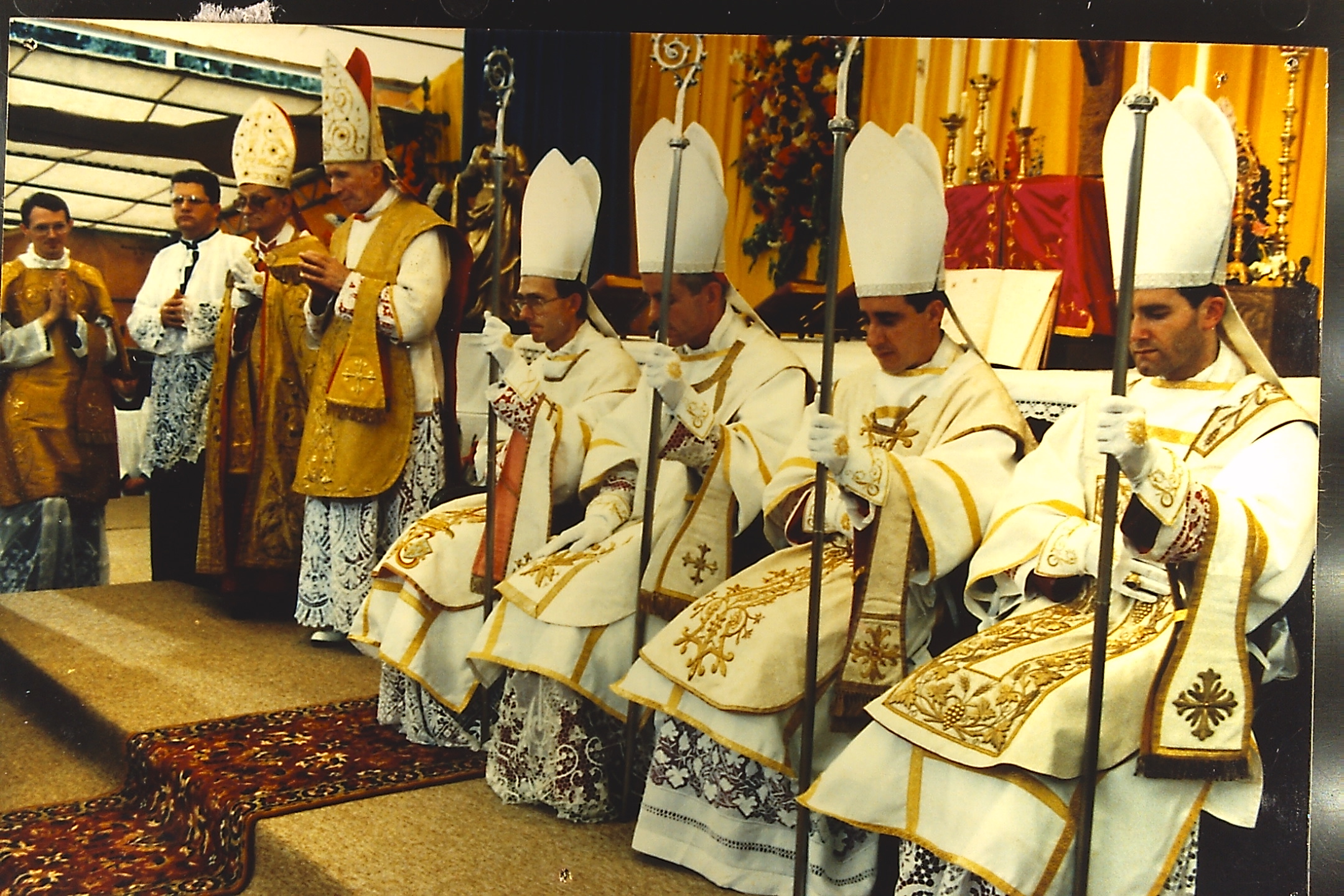
But I would like to make one thing clear; the bishops whom I consecrate, if I consecrate them, will have no special authority in the Society. Their sole function would be to ordain to the Priesthood and to give Confirmation. They would not have a territory or a region; the jurisdiction or ruling belongs to the Superior-General; it is he who is head of the Society, who posts people to positions and founds our houses.

In actual fact, the Superior-General is Father Schmidberger, who was elected by the General Chapter of 1982, for a term of twelve years, till 1994. It is he who succeeds me as the authority within the Society.
30 G. If we are not mistaken, you have used the plural when speaking of possible consecration of bishops.
Arch. L. If in conscience I deem it necessary to take this step, for the good of the work founded by me, I would not only ordain one, but I would proceed to three, four, perhaps five consecrations. The work has houses in the entire world, and I must take stock and think of the future.
30 G. Concretely speaking, what would stop you from doing such an openly ‘schismatical’ action?
Arch. L. If the Church situation would return to normal, if there was a return to Tradition, then there would be no more problem.
God alone is Master of the future
30 G. Your Grace, do you see a ‘return’ to Tradition? Do you think that it could come to pass in the years that remain to you?
Arch. L. God knows. Who can say what the future holds? Perhaps a nuclear conflict will break out and the situation will be radically changed … That such a change would come about under the present Pontificate, for the moment seems impossible, almost a miracle. But who knows?
30 G. What do you feel at the thought of dying unreconciled to the Church?
Arch. L. Only those who do not have the Faith are considered outside the Church, for the fundamental reason for unity in the Catholic Church is the Faith. Those who provoke schism are those who change the Faith. I am certain that I belong to the Catholic Faith as it has always been to the eternal Church.

30 G. In your vision of things, would the Pope be schismatic?
Arch. L. Yes perhaps … more or less. The meeting at Assisi constitutes a most grave fault. And if the Pope whose function it is to confirm the Faith does not fulfill his duty, what is one to do? Such a situation reaches the highest degrees of gravity. We have reached the gravest situation ever.
I cannot see any similar precedents in the Church’s history. In the 14th century, a Pope John XXII was condemned and deposed by special Council because on one point he was found not to be in conformity with Catholic Doctrine. Today the situation is much worse still: it is not one article but the whole context which is no longer Catholic.
30 G. Truly does the menace of excommunication on the part of the actual Catholic hierarchy leave you indifferent?
Arch. L. Absolutely indifferent. What value would there be in an excommunication handed down by the actual liberal government of the Church?
For more than a century conservative popes have condemned and excommunicated the Lamennais, Buonaiutis, the Loisys, because they were liberal and modernist. Now it is they who hold power in the Church and they wish to excommunicate the traditionalists, that is to say, the true Catholics.

_-_LABW_-_Staatsarchiv_Freiburg_W_134_Nr._111797b.jpeg)
Leave a Reply